ETF vs Mutual Fund: What’s the Difference and Which Is Better?
Choosing your first investment can feel overwhelming, especially when you’re deciding between an ETF vs Mutual Fund. Both are popular investment vehicles that allow you to invest in a diversified portfolio of stocks, bonds, or other assets without buying each investment individually.
While ETFs and mutual funds share many similarities, they differ in how they trade, their costs, tax efficiency, and investment flexibility.
In this guide, we’ll explain the key differences in simple terms so you can better understand how each works and which option may align with your financial goals.
Key Takeaways
- ETFs and mutual funds both provide diversification.
- ETFs trade throughout the day like individual stocks.
- Mutual funds are priced once daily after the market closes.
- ETFs generally have lower expense ratios.
- Mutual funds often support automatic recurring investments.
- Both can be suitable for long-term investing depending on your goals.
What is an ETF?
An Exchange-Traded Fund (ETF) is a collection of investments; such as stocks, bonds, or commodities—that trades on a stock exchange.
Instead of purchasing shares of dozens or even hundreds of individual companies, investors can buy a single ETF that provides exposure to an entire market or sector.
For example, one ETF might track the S&P 500, giving investors ownership in approximately 500 large U.S. companies through a single investment.
Benefits of ETFs
- Diversification
- Lower fees
- Easy to buy and sell
- Real-time pricing
- Tax-efficient structure
What Is a Mutual Fund?
A Mutual Fund pools money from many investors and is managed by professional fund managers who invest according to the fund’s objectives.
Unlike ETFs, mutual funds are bought directly from the fund company and are priced only once each trading day after the market closes.
Many retirement accounts and workplace investment plans include mutual funds because they support automatic investing and professional management.
What Is the Similarity Between an ETF vs Mutual Fund?
Before comparing ETF vs Mutual Fund, it’s helpful to understand what they have in common. Both are pooled investment vehicles that combine money from multiple investors to purchase a diversified portfolio of assets, such as stocks, bonds, or other securities.
Whether you choose an ETF vs Mutual Fund, you gain instant diversification without having to buy dozens of individual investments. Both can help reduce risk, support long-term wealth building, and are commonly used by beginner and experienced investors alike.
ETF vs Mutual Fund: Key Differences
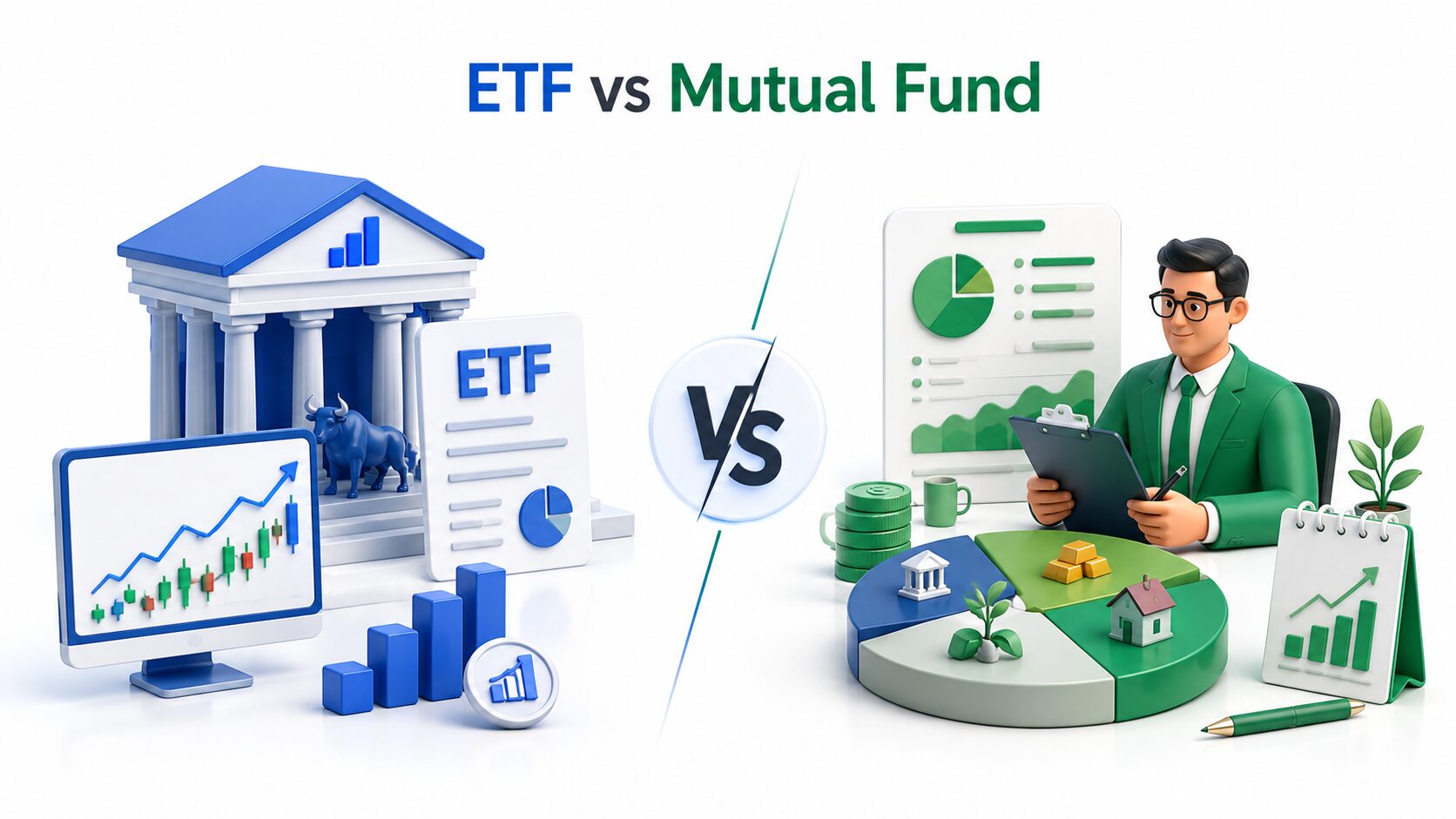
| Feature | ETF | Mutual Fund |
|---|---|---|
| Trading | Trades throughout the day | Trades once daily |
| Pricing | Real-time market price | End-of-day NAV |
| Management | Usually passive | Passive or active |
| Expense Ratio | Typically lower | Often higher |
| Minimum Investment | Price of one share | May require minimum investment |
| Tax Efficiency | Generally more tax-efficient | May distribute taxable gains |
| Automatic Investing | Limited at some brokers | Widely available |
| Intraday Trading | Yes | No |
ETF vs Mutual Fund: Costs
Investment costs may seem small, but they can have a significant impact on long-term returns.
ETFs
Many ETFs have low expense ratios because they simply track an index rather than relying on active management.
Mutual Funds
Actively managed mutual funds typically charge higher fees to cover research, portfolio management, and trading activities.
Over decades, even a difference of 0.50% in annual fees can meaningfully affect investment growth.
ETF vs Mutual Fund: Taxes
Taxes are another important consideration.
ETFs generally create fewer taxable events because of their unique creation and redemption process.
Mutual funds may distribute capital gains to investors when fund managers buy or sell securities, potentially creating taxable income even if you didn’t sell your investment.
Tax rules vary based on your personal circumstances and account type.
ETF vs Mutual Fund: Liquidity
Liquidity refers to how easily an investment can be bought or sold.
ETFs trade throughout the trading day, allowing investors to react to market movements immediately.
Mutual fund transactions are processed after the market closes using that day’s closing Net Asset Value (NAV).
ETF vs Mutual Fund: Management Style
Passive Investing
Most ETFs follow an index, such as the S&P 500 or Nasdaq-100.
Their objective is to match market performance rather than outperform it.
Active Investing
Many mutual funds employ professional portfolio managers who actively select investments in an effort to outperform the market.
Active management may provide opportunities for higher returns but often comes with higher costs.
Pros and Cons of ETFs
Pros
- Lower fees
- High liquidity
- Tax-efficient
- Easy diversification
- Transparent holdings
Cons
- Requires a brokerage account
- Prices fluctuate throughout the day
- Some niche ETFs may have lower trading volume
Pros and Cons of Mutual Funds
Pros
- Professional management
- Automatic investment plans
- Suitable for long-term investors
- Wide range of investment strategies
Cons
- Higher fees
- Less tax-efficient
- No intraday trading
- Possible minimum investment requirements
Which Is Better for Beginners?
There isn’t a universal winner. The better choice depends on your investing style.
An ETF may appeal to investors who value lower costs, flexibility, and passive investing.
A mutual fund may be suitable for those who prefer professional management, automatic monthly investments, or employer-sponsored retirement plans.
Understanding your investment objectives, risk tolerance, and time horizon is more important than choosing one product over the other.
Also, if you’re a young Professional, here’s an investing guide for you. Read Now.
Quick Decision Guide
| If You Want To… | Consider… |
|---|---|
| Trade throughout the day | ETF |
| Invest automatically every month | Mutual Fund |
| Minimize investment costs | ETF |
| Have a professional manager make decisions | Mutual Fund |
| Follow a market index | ETF |
| Keep investing simple through scheduled contributions | Mutual Fund |
Common Myths About ETF vs Mutual Fund
Many new investors misunderstand the differences between ETF vs Mutual Fund. Here are a few common myths:
Myth 1: ETFs always outperform mutual funds.
Reality: Performance depends on the underlying investments, not whether it’s an ETF or mutual fund.
Myth 2: Mutual funds are only for experienced investors.
Reality: Many beginners use mutual funds through retirement accounts and automatic investment plans.
Myth 3: ETFs are completely tax-free.
Reality: ETFs are generally more tax-efficient, but taxes may still apply depending on your account type and investment activity.
Myth 4: You must choose either ETFs or mutual funds.
Reality: Many investors own both as part of a diversified portfolio.
Common Mistakes Beginners Make
- Choosing investments based only on recent performance.
- Ignoring expense ratios.
- Investing without understanding the underlying holdings.
- Trying to time the market.
- Not diversifying investments.
- Overlooking tax implications.
- Making emotional investment decisions during market volatility.
Final Thoughts
When comparing ETF vs Mutual Fund, both investment options can play an important role in building long-term wealth.
ETFs generally offer lower costs, greater flexibility, and improved tax efficiency, while mutual funds provide professional management and convenient automatic investing features.
Rather than asking which investment is universally better, consider which aligns best with your financial goals, investing experience, and preferred investment approach.
Taking time to understand both options can help you make more informed investment decisions as your financial journey evolves.
Frequently Asked Questions
What is the main difference between an ETF and a mutual fund?
The primary difference is that ETFs trade throughout the day on stock exchanges, while mutual funds are priced and traded only once each trading day after the market closes.
Are ETFs safer than mutual funds?
Neither investment is inherently safer. Risk depends on the underlying investments held within the fund.
Which has lower fees: ETFs or mutual funds?
Many ETFs have lower expense ratios than actively managed mutual funds, although costs vary by fund.
Can beginners invest in ETFs?
Yes. ETFs are widely used by beginner investors because they offer diversification and relatively low costs.
Can I own both ETFs and mutual funds?
Yes. Many investors include both in their portfolios depending on their financial goals and investment strategy.
Do ETFs pay dividends?
Some ETFs distribute dividends if the underlying investments generate dividend income.
What is an expense ratio?
An expense ratio is the annual fee charged by a fund to cover operating and management costs.
Are mutual funds actively managed?
Some mutual funds are actively managed, while others passively track an index.
Recommended Reading
If you’re looking to build a stronger investing foundation, these beginner-friendly books are worth adding to your reading list: