
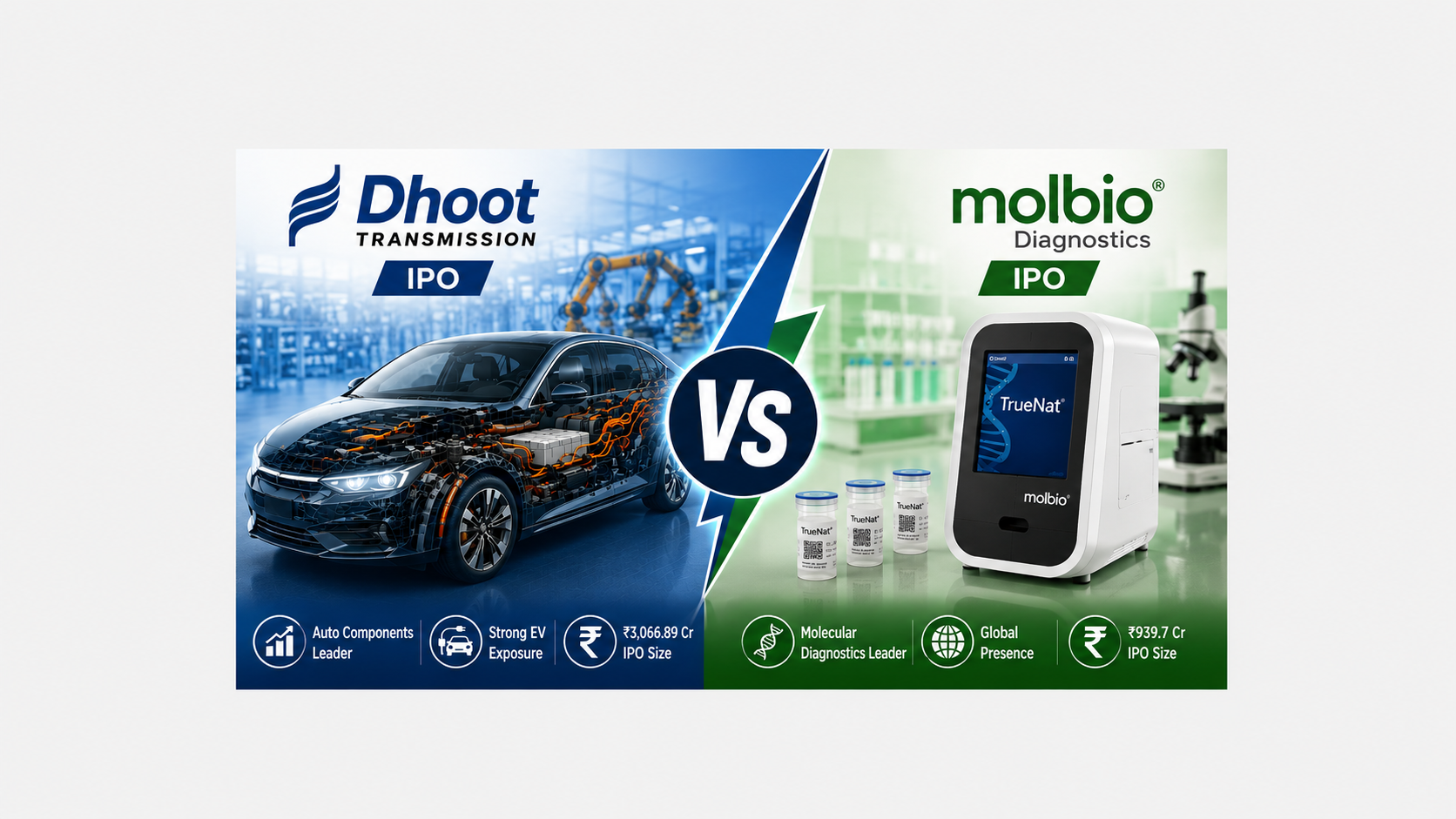
Dhoot Transmission vs Molbio Diagnostics IPO: Which One Should Investors Choose?
Investors facing a choice between Dhoot Transmission and Molbio Diagnostics have a relatively unusual problem this week: both IPOs opened on August 10 and both close on August 12, 2026.
The two companies, however, represent very different investment propositions.
Dhoot Transmission is an automotive components manufacturer with exposure to wiring harnesses, sensors, electronic components and the rapidly expanding electric-vehicle ecosystem.
Molbio Diagnostics, meanwhile, operates in molecular diagnostics, with its Truenat platform providing point-of-care testing across multiple diseases.
The difference becomes even more interesting when valuation is considered.
At the upper end of the price band, Dhoot Transmission is valued at roughly 35.7 times FY26 earnings, while Molbio is at around 54.6 times FY26 earnings based on reported EPS figures. Dhoot is therefore asking investors to pay considerably less for each rupee of current earnings. (Reddit)
Learn How to Apply for an IPO
Investors unfamiliar with the IPO application process can refer to our guide on How to Apply for an IPO before submitting an application.
Meanwhile, the unofficial grey market is currently signalling stronger listing expectations for Dhoot Transmission, with reports indicating a GMP of about 30%, versus around 17% for Molbio. GMP is unofficial and can change quickly, so it should not be treated as a guaranteed listing return. (The Economic Times)
That leaves investors with a key question:
If you can apply for only one, should you choose Dhoot Transmission or Molbio Diagnostics?
Dhoot Transmission vs Molbio: IPO Details
| Particular | Dhoot Transmission | Molbio Diagnostics |
| IPO size | ₹3,066.89 crore | ₹939.7 crore |
| Fresh issue | ₹1,400 crore | ~₹200 crore |
| Offer for sale | ~₹1,666.9 crore | ~₹739.7 crore |
| Price band | ₹829-871 | ₹768-807 |
| IPO dates | Aug 10-12, 2026 | Aug 10-12, 2026 |
| Lot size | 17 shares | 18 shares |
| Minimum investment | ₹14,807 | ₹14,526 |
| Business | Auto components | Molecular diagnostics |
| FY26 PAT | ~₹397 crore | ~₹164 crore |
| FY26 revenue/income | ~₹4,564 crore | ~₹1,455 crore |
| FY26 P/E at upper band | ~35.7x | ~54.6x |
| Current reported GMP | ~30% | ~17% |
| Listing | NSE, BSE | NSE, BSE |
Dhoot Transmission’s final price band was set at ₹829-871, while Molbio’s band is ₹768-807. Both issues opened on August 10 and close on August 12. (The Economic Times)
1. Business Model: Dhoot vs Molbio
Dhoot Transmission: Riding Auto and EV Electrification
Dhoot Transmission manufactures electrical and electronic components used in vehicles, including wiring harnesses, sensors and controllers.
The company has a particularly strong position in two-wheelers and three-wheelers, including electric vehicles.
Its business is therefore tied to several structural themes:
- Growth in India’s automobile market
- Increasing electronic content in vehicles
- EV adoption
- Expansion of wiring-harness applications
- Outsourcing by automotive OEMs
Dhoot’s updated IPO filing with SEBI provides details of its proposed fresh issue and expansion plans. The company intends to use a portion of the fresh proceeds for debt reduction and new manufacturing facilities. (Securities and Exchange Board of India)
Molbio: A Healthcare Technology Play
Molbio’s business is fundamentally different.
Its flagship Truenat platform is designed for point-of-care molecular diagnostics, allowing testing closer to where patients receive care.
The company’s opportunity lies in expanding molecular diagnostics across India and overseas markets, while increasing the installed base of diagnostic devices and recurring demand for test kits.
Molbio’s DRHP was filed with SEBI in 2025 and describes the company’s diagnostics business and Truenat platform. (Securities and Exchange Board of India)
Verdict on business model:
There is no clear winner. Dhoot offers exposure to industrial manufacturing, auto and EV electrification, while Molbio offers exposure to healthcare technology and diagnostics.
For investors looking for a cyclical manufacturing story, Dhoot has the edge.
For investors seeking a healthcare technology story, Molbio is more differentiated.
⸻
2. Revenue Growth: Dhoot Has the Edge
Dhoot Transmission’s revenue growth has been particularly strong.
Total income increased from approximately ₹2,799 crore in FY24 to around ₹4,564 crore in FY26, representing growth of about 63% over two years. (Reddit)
Molbio’s income also increased substantially, rising from around ₹837 crore in FY24 to approximately ₹1,455 crore in FY26.
Revenue comparison
| ₹ crore | Dhoot FY24 | Dhoot FY26 | Molbio FY24 | Molbio FY26 |
| Revenue/Income | ~2,799 | ~4,564 | ~837 | ~1,455 |
| Growth | — | ~63% | — | ~74% |
On a two-year basis, Molbio’s top-line growth is actually higher, although the companies operate at very different scales.
Dhoot, however, has achieved its growth on a much larger revenue base.
Verdict: Molbio on percentage growth; Dhoot on scale.
⸻
3. Profit Growth: Molbio vs Dhoot
Dhoot’s PAT increased from approximately ₹299 crore in FY24 to ₹397 crore in FY26.
Molbio’s PAT increased from ₹83.5 crore to around ₹164 crore over the same period.
Profit comparison
| ₹ crore | FY24 PAT | FY26 PAT | Approx. growth |
| Dhoot Transmission | ~₹299 crore | ~₹397 crore | ~33% |
| Molbio Diagnostics | ₹83.5 crore | ~₹164 crore | ~97% |
This is one area where Molbio stands out.
Its profit has almost doubled over the two-year period, although the company started from a significantly smaller base.
Dhoot’s absolute profit is much larger, but Molbio has demonstrated faster bottom-line growth.
Verdict: Molbio.
⸻
4. Valuation: Dhoot Transmission Has the Clear Advantage
This is perhaps the most important difference between the two IPOs.
At the upper price band:
Dhoot Transmission
P/E: ~35.7x FY26 earnings
Molbio Diagnostics
P/E: ~54.6x FY26 earnings
Dhoot’s IPO valuation is also below the average P/E of the listed peers cited in its IPO comparison, which was around 55.3x in the analysis of its offer documents. (Reddit)
That doesn’t automatically make Dhoot cheap.
A lower multiple can reflect differences in business quality, margins, growth visibility, cyclicality or balance-sheet risk.
But investors are clearly paying a smaller premium for Dhoot’s current earnings.
Verdict: Dhoot Transmission.
⸻
5. IPO Structure: Neither Is Particularly Attractive on OFS
Both IPOs have substantial offer-for-sale components.
Dhoot Transmission
- Fresh issue: ₹1,400 crore
- OFS: approximately ₹1,667 crore
Molbio Diagnostics
- Fresh issue: approximately ₹200 crore
- OFS: approximately ₹740 crore
Dhoot’s IPO is larger, but the company is also raising substantially more fresh capital.
For Dhoot, the fresh issue is intended partly toward debt reduction and new manufacturing capacity. (The Economic Times)
Molbio’s fresh issue is much smaller relative to the overall IPO.
This means investors should distinguish between money raised by the company and money received by selling shareholders.
Verdict: Dhoot Transmission, because its fresh capital component is materially larger.
⸻
6. GMP: Dhoot Transmission Is Currently Ahead
Grey-market sentiment is currently strongly in favour of Dhoot Transmission.
Reports on August 11 indicated:
- Dhoot Transmission GMP: ~30%
- Molbio GMP: ~17%
At the upper price band, that would imply an unofficial grey-market indication of approximately:
Dhoot: ₹871 + ~₹261 = ~₹1,132
Molbio: ₹807 + ~₹137 = ~₹944
These are not listing-price forecasts.
Grey-market premiums are unofficial, can change rapidly and may not translate into actual listing gains. (The Economic Times)
Still, as a snapshot of current market sentiment, Dhoot has the stronger signal.
Verdict: Dhoot Transmission.
⸻
7. Subscription Momentum
Dhoot Transmission received a strong opening-day response.
By the first day, approximately 44% of the issue had been subscribed, while the retail portion had reached around 57% subscription, according to reported bidding data. (The Economic Times)
Molbio also attracted investor interest, with its second-day grey-market premium rising to around 17%. (The Economic Times)
The final subscription numbers on August 12 will be more meaningful than the early-day figures.
For investors deciding between the two, however, the combination of subscription momentum + GMP currently favours Dhoot.
⸻
8. Growth Drivers: Which Company Has the Bigger Opportunity?
Dhoot Transmission
The key growth drivers are:
- EV adoption
- Rising electronic content per vehicle
- Growth in two- and three-wheelers
- Increasing outsourcing by OEMs
- New manufacturing capacity
- Expansion into new vehicle platforms
The EV opportunity is particularly relevant because wiring harnesses and electrical/electronic content become increasingly important as vehicles become more electronically complex.
Molbio Diagnostics
Molbio’s growth drivers include:
- Increased molecular diagnostics adoption
- Decentralised healthcare testing
- International expansion
- Larger Truenat installed base
- Recurring diagnostic-kit demand
- Expansion into additional disease categories
The healthcare story potentially has a longer structural runway, but investors are paying considerably more for it.
Verdict:
Near-to-medium-term visibility: Dhoot
Structural healthcare opportunity: Molbio
⸻
9. Risks: Dhoot vs Molbio
Dhoot Transmission — Key Risks
Auto-sector cyclicality
A slowdown in vehicle production can affect component suppliers.
Customer concentration
Dependence on major automotive OEMs creates bargaining and concentration risks.
Debt
Borrowings increased during the expansion phase, making deleveraging an important post-IPO metric. (Reddit)
Margin pressure
Rapid revenue growth does not necessarily translate into equivalent profit growth.
EV transition
While EV adoption is an opportunity, changes in vehicle architecture and customer technology can also require continuous investment.
Molbio Diagnostics — Key Risks
Premium valuation
At around 54.6x FY26 earnings, expectations are high.
Government and institutional dependence
Government programmes and institutional procurement are meaningful contributors to the business.
Product concentration
TB diagnostics remain important to the business.
Execution risk
International expansion and new product categories need to scale for the valuation to remain justified.
Smaller scale
Molbio is considerably smaller than Dhoot in revenue and profit terms.
Verdict on risk: Neither is low-risk, but Molbio carries greater valuation risk, while Dhoot carries greater cyclical and industrial risk.
⸻
10. Dhoot Transmission vs Molbio: Head-to-Head Scorecard
| Factor | Winner | Why |
| Revenue scale | Dhoot | Much larger business |
| Revenue growth | Molbio | Faster percentage growth |
| Profit growth | Molbio | PAT nearly doubled over FY24-FY26 |
| Absolute profitability | Dhoot | Much higher PAT |
| Valuation | Dhoot | ~35.7x vs ~54.6x P/E |
| GMP | Dhoot | ~30% vs ~17% |
| Fresh capital raised | Dhoot | ₹1,400 crore vs ~₹200 crore |
| EV exposure | Dhoot | Direct auto-component exposure |
| Healthcare opportunity | Molbio | Molecular diagnostics |
| International opportunity | Molbio | Truenat expansion |
| Cyclicality | Molbio | Lower exposure to auto cycle |
| Valuation risk | Dhoot | Lower P/E |
| Technology differentiation | Molbio | Proprietary diagnostics platform |
| Listing-gain appeal | Dhoot | Stronger GMP currently |
| Long-term thematic appeal | Tie | EV vs healthcare |
⸻
Dhoot Transmission vs Molbio: Which IPO Is Better for Investors?
The answer depends on what the investor is looking for.
For listing gains: Dhoot Transmission
Dhoot currently has the stronger grey-market premium and a robust opening-day subscription response.
That makes it the more attractive candidate for investors primarily focused on potential listing performance.
However, GMP can change before listing and should not be treated as a guaranteed return.
For valuation: Dhoot Transmission
At around 35.7x FY26 earnings versus Molbio’s roughly 54.6x, Dhoot offers substantially better valuation comfort.
The discount to its listed peer-group P/E is another positive, although peer comparisons should not be made solely on P/E.
For earnings growth: Molbio Diagnostics
Molbio’s PAT has expanded much faster over the past two years.
Its molecular diagnostics platform also gives investors exposure to a different and potentially structurally attractive healthcare segment.
For conservative valuation-conscious investors: Dhoot Transmission
Neither IPO is cheap in absolute terms.
But Dhoot offers a more comfortable entry multiple and a larger fresh issue, including debt-reduction and capacity-expansion plans.
For high-risk, high-growth investors: Molbio Diagnostics
Investors willing to pay a premium for differentiated healthcare technology may prefer Molbio.
The trade-off is clear: higher growth potential, but also a higher valuation hurdle.
Our Verdict: Dhoot Transmission vs Molbio
WINNER FOR MOST INVESTORS: DHOOT TRANSMISSION
Dhoot Transmission: ★★★★☆
Molbio Diagnostics: ★★★½☆
Listing-gain appeal: Dhoot Transmission
Valuation: Dhoot Transmission
Profit growth: Molbio Diagnostics
Business differentiation: Molbio Diagnostics
Risk-reward at IPO price: Dhoot Transmission
Long-term thematic opportunity: Both
Why Dhoot Transmission Edges Ahead
Dhoot Transmission gets the edge because investors are paying a significantly lower earnings multiple for a company that has delivered strong revenue growth, has exposure to automotive electrification and is using a meaningful portion of fresh capital to strengthen its balance sheet and manufacturing capacity.
The stronger current GMP is an additional positive for listing-focused investors, although it should carry less weight than fundamentals.
Molbio, meanwhile, remains an interesting company with faster profit growth and a differentiated molecular-diagnostics platform.
The problem is price.
At around 54.6x FY26 earnings, Molbio requires investors to have considerably greater confidence in future growth than Dhoot does at around 35.7x.
The Bottom Line
If an investor has money for only one of the two IPOs, Dhoot Transmission currently offers the better risk-reward at the IPO price.
If the objective is long-term exposure to healthcare technology and the investor is comfortable with premium valuations, Molbio Diagnostics remains worth considering.
The distinction is therefore:
Dhoot Transmission = better valuation + stronger GMP + EV/auto growth
Molbio Diagnostics = differentiated healthcare technology + faster profit growth + higher valuation
For investors with a limited IPO budget, Dhoot Transmission gets the first preference, while Molbio Diagnostics comes second.
That ranking should be revisited after the final subscription data and before listing, particularly if either IPO’s grey-market premium changes materially.
Disclaimer: This comparison is for informational purposes only and does not constitute investment advice. IPO investments involve market risk and investors can lose capital. Investors should read the respective offer documents, statutory disclosures and risk factors carefully before applying.
FAQs (Frequently Asked Questions)
Question 1: Which IPO is better, Dhoot Transmission or Molbio Diagnostics?
Answer: Based on valuation, current grey-market sentiment and the structure of the fresh issue, Dhoot Transmission currently offers a more favourable risk-reward at the IPO price. Molbio Diagnostics offers faster profit growth and exposure to molecular diagnostics but comes at a higher valuation.
Question 2: What is the price band of Dhoot Transmission IPO?
Answer: Dhoot Transmission’s IPO price band is ₹829 to ₹871 per share.
Question 3: What is the price band of Molbio Diagnostics IPO?
Answer: Molbio Diagnostics’ IPO price band is ₹768 to ₹807 per share.
Question 4: When do Dhoot Transmission and Molbio Diagnostics IPOs close?
Answer: Both Dhoot Transmission and Molbio Diagnostics IPOs opened on August 10, 2026 and close on August 12, 2026.
Question 5: Which IPO has the lower valuation, Dhoot Transmission or Molbio?
Answer: Dhoot Transmission has the lower valuation. At the upper price band, Dhoot is valued at approximately 35.7 times FY26 earnings, compared with around 54.6 times for Molbio Diagnostics.
Question 6: Which IPO has the higher GMP, Dhoot Transmission or Molbio?
Answer: Dhoot Transmission currently has the higher reported grey-market premium. Recent reports indicated a GMP of around 30% for Dhoot Transmission versus approximately 17% for Molbio Diagnostics. GMP is unofficial and can change before listing.
Question 7: Which IPO has better profit growth?
Answer: Molbio Diagnostics has recorded faster percentage profit growth. Its PAT increased from approximately ₹83.5 crore in FY24 to around ₹164 crore in FY26, while Dhoot Transmission’s PAT increased from approximately ₹299 crore to ₹397 crore over the same period.
Question 8: Which IPO is better for listing gains?
Answer: Based on the current grey-market premium, Dhoot Transmission appears more attractive for investors targeting potential listing gains. However, GMP is unofficial and does not guarantee the actual listing price.
Question 9: Which IPO is better for long-term investment?
Answer: Dhoot Transmission may offer better valuation comfort, while Molbio Diagnostics offers exposure to a differentiated molecular-diagnostics platform with faster recent profit growth. The better choice depends on an investor’s risk tolerance, valuation preference and investment horizon.
Question 10: Is Dhoot Transmission IPO cheaper than Molbio Diagnostics IPO?
Answer: Yes. At the upper price band, Dhoot Transmission trades at approximately 35.7 times FY26 earnings, compared with around 54.6 times FY26 earnings for Molbio Diagnostics.
Question 11: What are the main risks of Dhoot Transmission IPO?
Answer: Key risks include exposure to automotive cycles, customer concentration, borrowings, margin pressure and the need to continuously invest as automotive technology and EV architectures evolve.
Question 12: What are the main risks of Molbio Diagnostics IPO?
Answer: Key risks include its premium valuation, dependence on government and institutional procurement, product concentration, international execution risk and the need to sustain strong earnings growth.