
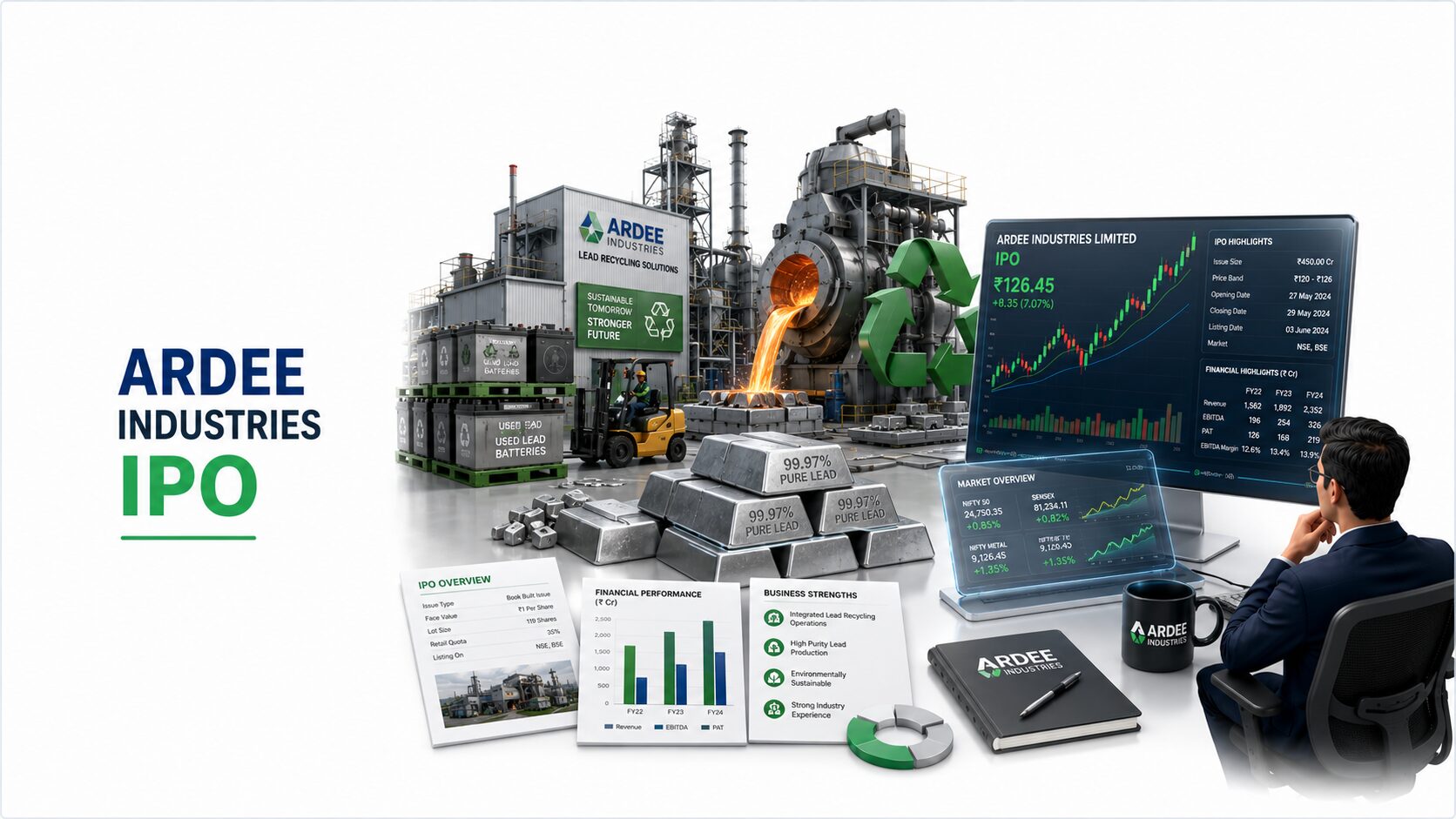
Ardee Industries IPO: Can India’s Circular Economy Story Deliver Strong Returns?
India’s push towards a circular economy is creating new opportunities for businesses involved in recycling and resource recovery. One such company is Ardee Industries Limited, whose upcoming Ardee Industries IPO has caught investors’ attention as demand for lead recycling continues to grow alongside the automotive and energy storage sectors.
However, recycling businesses are also heavily influenced by commodity prices, environmental regulations, and raw material availability. So, does the Ardee Industries IPO offer a compelling long-term opportunity, or should investors remain cautious?
In this detailed review, we’ll analyse the Ardee Industries IPO, covering the company’s business model, financial performance, industry outlook, valuation, GMP, risks, and whether investors should consider subscribing.
How to Analyze an IPO Before Investing: A Complete Beginner’s Guide
Ardee Industries IPO Details
| Particular | Details |
| Issue Size | ₹425.87 crore |
| Price Band | ₹50–53 per share |
| IPO Opens | August 5 |
| IPO Closes | August 7 |
| Listing | NSE & BSE |
| Fresh Issue | ₹320 crore |
| Offer for Sale | ₹105.87 crore |
| Face Value | ₹2 per share |
Tentative Timeline
- Anchor Allocation: August 4
- Basis of Allotment: August 10
- Shares Credited: August 11
- Tentative Listing: August 12
About Ardee Industries
Ardee Industries is engaged in the recycling of lead and non-ferrous metals, sourcing end-of-life batteries and metal scrap to produce refined lead and related products.
Its operations are aligned with India’s increasing emphasis on resource efficiency, battery recycling and environmental sustainability. Demand for recycled lead is expected to remain supported by automotive batteries, industrial batteries and energy storage applications.
How Will the Ardee Industries IPO Proceeds Be Used?
According to the offer documents, the fresh issue proceeds will primarily be used for:
- Funding incremental working capital requirements
- Repayment or prepayment of certain borrowings
- General corporate purposes
Reducing debt and strengthening working capital could improve financial flexibility, particularly in a business where inventory procurement and commodity price movements play an important role.
Industry Outlook: Riding the Circular Economy Wave
India is witnessing increased regulatory focus on recycling, waste management and sustainable manufacturing.
Several structural factors support the industry:
- Rising consumption of lead-acid batteries
- Growing replacement demand in automobiles
- Expansion of renewable energy storage
- Government emphasis on recycling and resource recovery
These trends could provide long-term demand support for organized recyclers.
However, the industry remains highly competitive and sensitive to fluctuations in metal prices.
Financial Performance
Before applying for the Ardee Industries IPO, investors should closely evaluate the company’s financial performance to understand whether its operational growth is translating into stronger profitability and cash generation.
| Particular (FY25) | Value |
|---|---|
| Revenue | ₹742.74 Cr |
| EBITDA | ₹65.93 Cr |
| Profit After Tax | ₹33.27 Cr |
| Installed Capacity | 104,390 MTPA |
| Production | 46,980 MT |
| Capacity Utilisation | 45% |
Source: SEBI
Grey Market Premium (GMP)
As of 3 August 2026, the Ardee Industries IPO is commanding an unofficial Grey Market Premium (GMP) of around 13%, indicating positive market sentiment ahead of the issue. However, GMP is unofficial, changes frequently, and should be considered only as a sentiment indicator rather than the primary reason to invest.
Key Strengths of Ardee Industries IPO
Growing Recycling Industry
India’s transition towards a circular economy is expected to increase demand for organized recycling companies.
Beneficiary of Battery Demand
Lead continues to be an important raw material for conventional batteries used across automotive and industrial applications.
Improving Scale
A successful IPO could strengthen the company’s balance sheet and provide additional capital for future expansion.
Key Risks Investors Should Consider
Commodity Price Volatility
Lead prices fluctuate based on global demand, supply dynamics and economic conditions, which can impact margins.
Raw Material Availability
The business depends on a steady supply of used batteries and metal scrap. Any disruption could affect production volumes.
Environmental Regulations
Lead recycling is subject to stringent environmental and pollution-control regulations. Compliance costs and regulatory changes remain key risks.
Competitive Industry
The company operates in a fragmented market with competition from both organized and unorganized players.
Valuation: Is the IPO Fairly Priced?
As the final prospectus becomes available, investors should evaluate the Ardee Industries IPO on the following parameters:
- Price-to-Earnings (P/E) versus listed peers
- Return on Equity (ROE)
- EBITDA margins
- Cash flow generation
- Debt levels
- Revenue and profit growth
- Return on Capital Employed (ROCE)
A meaningful comparison with listed recycling and metal companies will be important to determine whether the issue is reasonably priced.
Bull Case
- Exposure to India’s long-term recycling and sustainability theme.
- Fresh capital may strengthen the balance sheet and support growth.
- Structural demand from automotive, industrial and energy-storage sectors.
- Potential operating leverage if capacity utilization improves.
Bear Case
- Earnings remain sensitive to lead price volatility.
- Regulatory compliance costs could increase.
- Margins may fluctuate with raw material availability.
- Commodity businesses generally command lower valuation multiples than asset-light sectors.
Investor Takeaway
Ardee Industries IPO offers investors exposure to a niche segment that could benefit from India’s growing emphasis on recycling and resource efficiency. The company operates in an industry with long-term structural tailwinds, but it also faces cyclical risks tied to commodity prices, environmental regulations and raw material sourcing.
Rather than relying on grey market activity, investors should focus on the company’s financial performance, valuation relative to peers and execution capabilities. For long-term investors, the Ardee Industries IPO may be worth considering if the final pricing leaves room for earnings growth and the company’s fundamentals justify the valuation.
Conclusion
Ardee Industries’ IPO arrives at a time when sustainability-focused businesses are gaining investor attention. The company’s presence in lead recycling and the circular economy provides a differentiated investment proposition, while the fresh capital is expected to support working capital needs and debt reduction.
The investment case ultimately depends on whether the company can translate favourable industry trends into consistent earnings growth while managing commodity and regulatory risks. Investors should review the final prospectus, financial metrics and peer valuations before making a subscription decision rather than basing their decision on grey market premiums alone.
Checkout our analysis of the upcoming IPO
Frequently Asked Questions (FAQs)
1. When does the Ardee Industries IPO open and close?
The IPO will open for subscription on August 5, 2026, and close on August 7, 2026.
2. What is the size of the Ardee Industries IPO?
The company aims to raise ₹425.87 crore through the public issue.
3. What is the price band of the IPO?
The IPO has been priced in the range of ₹50 to ₹53 per equity share.
4. Is the IPO a fresh issue or an Offer for Sale (OFS)?
The Ardee Industries IPO consists of:
- Fresh Issue: ₹320 crore
- Offer for Sale (OFS): ₹105.87 crore
5. What does Ardee Industries do?
Ardee Industries is engaged in the recycling and recovery of lead-based materials and non-ferrous metal scrap. It manufactures refined lead and lead alloys used in batteries, automotive components, industrial equipment and energy storage applications.
6. How will the company use the IPO proceeds?
The proceeds from the fresh issue will primarily be used for:
- Funding working capital requirements
- Repayment/prepayment of certain borrowings
- General corporate purposes
7. What are the company’s key strengths?
Some of the company’s strengths include:
- Exposure to India’s growing battery recycling and circular economy sector.
- London Metal Exchange (LME)-approved lead ingot brand.
- Installed recycling capacity of over 104,000 MT per annum.
- Presence in both domestic and export markets.
8. What are the major risks?
Investors should consider:
- Volatility in global lead prices.
- Dependence on the availability of scrap batteries and lead scrap.
- Strict environmental and pollution-control regulations.
- Competition from organized and unorganized recyclers.
9. What is the Grey Market Premium (GMP) of Ardee Industries IPO?
As of the latest market updates, the IPO is commanding an unofficial Grey Market Premium (GMP) of around 13% over the upper price band. Investors should note that GMP is not regulated and should not be the sole basis for investment decisions.
10. Who can apply for the IPO?
The IPO is open to:
- Retail Individual Investors (RIIs)
- Non-Institutional Investors (NIIs/HNIs)
- Qualified Institutional Buyers (QIBs)
subject to the allocation norms specified in the prospectus.
11. How can investors apply?
Investors can apply through:
- ASBA via net banking
- UPI-enabled broker platforms
- Trading apps offering IPO applications
12. When is the expected listing date?
The shares are expected to list on the NSE and BSE on August 12, 2026, subject to the completion of the allotment process.
13. Is Ardee Industries profitable?
According to the company’s disclosed financials, Ardee Industries reported:
- Total Income (FY25): ₹743.53 crore
- Profit After Tax (FY25): ₹33.27 crore
- EBITDA (FY25): ₹65.93 crore
14. Should long-term investors consider subscribing?
The IPO provides exposure to India’s expanding lead recycling and circular economy theme. Long-term investors should evaluate:
- Valuation relative to listed peers.
- Earnings growth sustainability.
- Debt reduction plans.
- Raw material sourcing capabilities.
- Commodity price risks.
As with any IPO, investors should review the Red Herring Prospectus (RHP) and assess whether the valuation aligns with the company’s long-term growth prospects before making an investment decision.
Want to know How To Apply For IPOs? Read here
Developing strong investing habits starts with building healthy financial habits. If you’re new to personal finance, our guide on Money Habits for Young Professionals can help you create a stronger financial foundation before investing in IPOs.
Want to deepen your investing knowledge? Here are some of the best books every IPO and stock market investor should read.
1. The Intelligent Investor – Benjamin Graham
The classic guide to value investing and understanding a company’s true worth.
2. One Up On Wall Street – Peter Lynch
Learn how to identify great companies before they become market favorites.
3. The Psychology of Money – Morgan Housel
Master the mindset required to become a successful long-term investor.