South Korea Stock Market Crash Explained: What Happened, Why It Happened, and What’s Next?
Just weeks ago, South Korea’s stock market was one of the world’s strongest performers, fueled by optimism around artificial intelligence (AI), semiconductor stocks, and robust technology earnings. Then, almost overnight, sentiment changed.
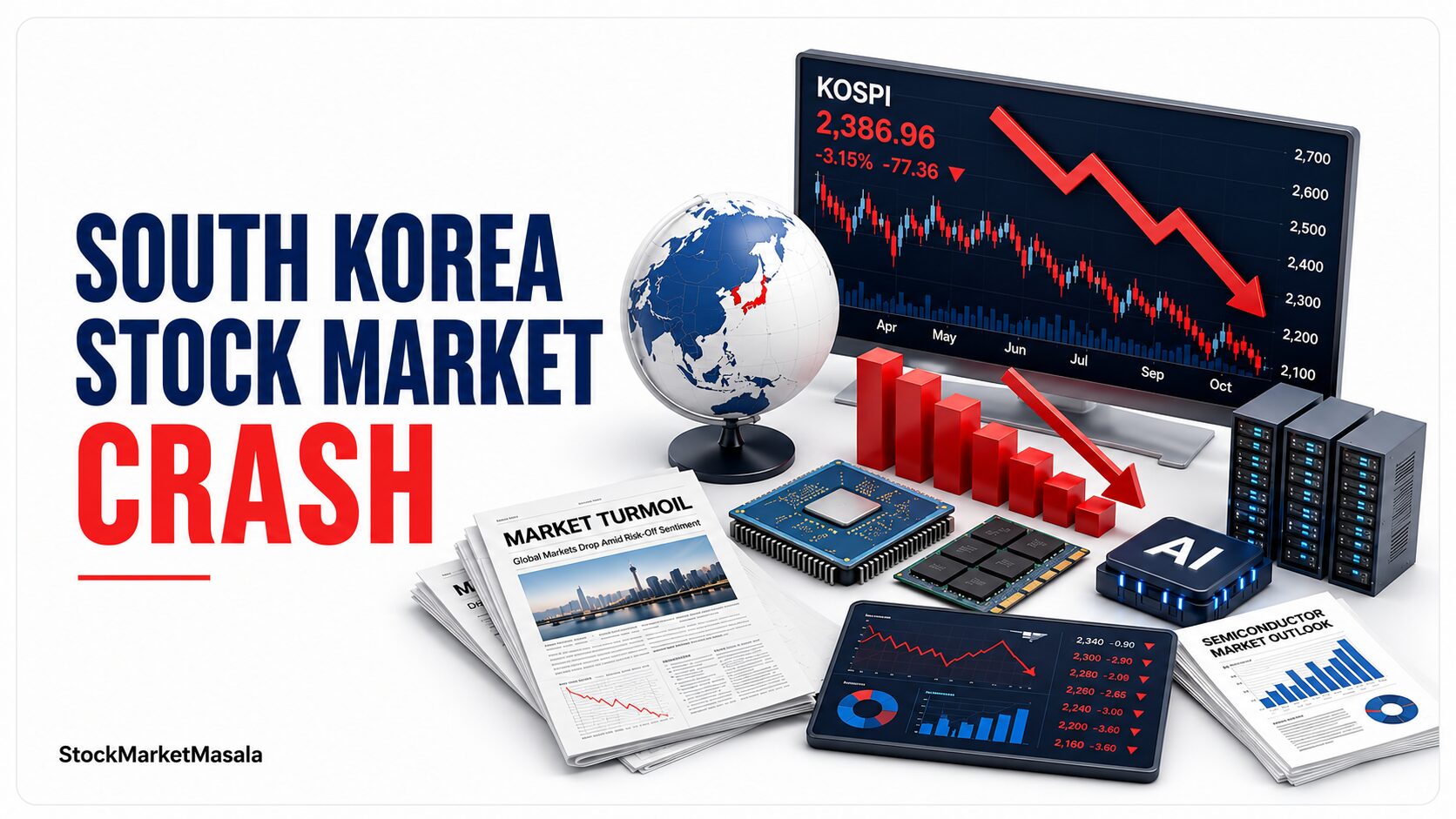
The benchmark KOSPI index suffered one of its sharpest declines in recent years, triggering trading halts and wiping out hundreds of billions of dollars in market value. Major companies such as Samsung Electronics and SK Hynix led the sell-off, raising concerns about whether the global AI rally was beginning to lose momentum.
But was this simply a correction after a massive rally, or does it signal a bigger problem for global markets?
In this article, we’ll explain what caused the South Korea stock market crash, why investors around the world are paying attention, and what could happen next.
Key Takeaways
- South Korea’s KOSPI index plunged sharply as technology and semiconductor stocks came under heavy selling pressure.
- The sell-off was driven by a combination of AI-related concerns, higher interest rates, profit booking, and leveraged trading.
- Samsung Electronics and SK Hynix, which carry significant weight in the KOSPI, amplified the market decline.
- Despite the correction, South Korea remains one of the world’s most important semiconductor markets.
- Investors are now watching corporate earnings, AI demand, interest rates, and geopolitical developments for clues about the market’s next move.
What Happened?
South Korea’s benchmark KOSPI index experienced a dramatic sell-off, at one point falling more than 10% in a single trading session, prompting the Korea Exchange to activate a market-wide circuit breaker that temporarily halted trading. Such measures are designed to calm markets during periods of extreme volatility.
The decline was led by technology and semiconductor companies, with Samsung Electronics and SK Hynix suffering steep losses. Because these companies represent a large share of the KOSPI, weakness in their share prices had an outsized impact on the broader market.
The correction also spread beyond South Korea, weighing on investor sentiment across other Asian technology markets.
Why Did the South Korea Stock Market Crash?
There wasn’t a single trigger. Instead, several factors came together, causing investors to rapidly reduce risk.
1. AI Optimism Began to Cool
Over the past two years, South Korea’s market had benefited enormously from the global AI boom.
Companies such as Samsung Electronics and SK Hynix became major beneficiaries because they supply high-bandwidth memory (HBM) chips used in AI servers and data centers.
However, investors recently began questioning whether the pace of AI infrastructure spending could continue indefinitely. As expectations became more cautious, technology stocks that had previously led the rally came under significant selling pressure.
2. Higher Interest Rates Reduced Risk Appetite
The Bank of Korea’s interest rate increase also contributed to the sell-off.
Higher interest rates increase borrowing costs for businesses and consumers while reducing the present value of future earnings. Growth-oriented technology companies are often more sensitive to these changes because much of their valuation depends on expected future growth.
As a result, investors shifted away from high-growth technology stocks toward safer assets.
3. Profit Booking After a Massive Rally
Before the correction, the KOSPI had delivered exceptional gains and was among the world’s best-performing equity markets.
When markets rise rapidly over a short period, many investors choose to lock in profits. This wave of selling can accelerate quickly, especially when valuations become stretched.
In South Korea’s case, profit-taking added further pressure to an already nervous market.
4. Leveraged Trading Made the Decline Worse
One of the biggest reasons the decline became so severe was the widespread use of leveraged investment products.
Many retail investors had invested through leveraged single-stock ETFs and margin trading. As stock prices fell, margin calls forced additional selling, creating a domino effect that accelerated the market decline.
This type of forced liquidation often causes markets to fall much faster than fundamentals alone would suggest.
5. Semiconductor Stocks Carried Too Much Weight
Unlike more diversified markets, South Korea’s stock market is heavily influenced by a small number of semiconductor companies.
Samsung Electronics and SK Hynix together represent a substantial portion of the KOSPI. When both companies experienced sharp declines, the broader index also fell significantly.
This concentration makes the Korean market especially sensitive to changes in global semiconductor demand.
Why the Whole World Is Watching
Although the sell-off happened in South Korea, its implications extend far beyond one country.
South Korea plays a critical role in the global semiconductor supply chain. Samsung Electronics and SK Hynix manufacture memory chips that power products from smartphones and laptops to cloud computing infrastructure and AI data centers.
Many of the world’s largest technology companies—including Apple, NVIDIA, AMD, Microsoft, Amazon, and Google—depend directly or indirectly on this supply chain.
As a result, weakness in South Korean semiconductor stocks often influences investor sentiment toward global technology stocks.
Is This the Beginning of Another Financial Crisis?
At this stage, most analysts do not view the correction as comparable to the 2008 Global Financial Crisis.
Unlike 2008, the current sell-off has not been driven by widespread banking failures or a collapse in the financial system.
Not every sharp market decline turns into a financial crisis. If you’re new to investing, understanding the difference between a stock market crash, a market correction, and a bear market can help you put short-term volatility into perspective. Read our detailed guide on What Is a Stock Market Crash? to learn how these events occur and what history teaches investors.
Instead, it appears to be a combination of:
- Cooling expectations around AI spending
- Higher interest rates
- Profit-taking after a strong rally
- Heavy leverage in parts of the market
While volatility may continue, many analysts still believe that the long-term demand for semiconductors remains intact, even if short-term expectations become more realistic.
What’s Next?
No one can predict where markets will move next, but investors are likely to focus on several important developments.
Corporate Earnings
Upcoming earnings from Samsung Electronics, SK Hynix, and major U.S. technology companies will provide clues about whether AI-related demand remains strong.
AI Infrastructure Spending
Investors will watch whether companies continue investing heavily in AI servers, cloud infrastructure, and semiconductor capacity.
Central Bank Decisions
Interest rate decisions from the U.S. Federal Reserve, the Bank of Korea, and other major central banks could influence investor appetite for technology stocks.
Global Semiconductor Demand
Any signs of improving or weakening demand for memory chips, AI hardware, and data center equipment will likely have a direct impact on South Korean equities.
Geopolitical Developments
Global trade policies, supply chain disruptions, and regional geopolitical tensions could continue affecting investor sentiment.
What Investors Can Learn From This Crash
Market corrections are a normal part of investing, especially after extended rallies.
Rather than reacting emotionally, long-term investors often focus on understanding why markets are moving instead of simply following headlines.
Some key lessons include:
- Avoid concentrating too much of your portfolio in one sector. Read more on 50-30-20 Budget Rule
- Be cautious when markets are driven by excessive optimism.
- Understand the risks of leverage and margin trading.
- Focus on company fundamentals rather than short-term market sentiment.
- Diversification remains one of the most effective ways to manage investment risk.
Final Thoughts
The South Korea stock market crash serves as a reminder that even the strongest markets can experience sharp corrections when expectations change.
While concerns about AI spending, rising interest rates, and leveraged trading contributed to the recent decline, South Korea continues to play a central role in the global technology and semiconductor industry.
For investors, the key takeaway isn’t whether the market fell—it is understanding why it fell. Separating short-term market volatility from long-term business fundamentals is often one of the most valuable skills any investor can develop.
As global markets continue to evolve, keeping an eye on earnings, semiconductor demand, and central bank policy will be just as important as watching the daily movement of stock indices.
FAQ Section
1. Why did the South Korea stock market crash?
The South Korea stock market crashed due to a combination of factors, including concerns over AI-related valuations, higher interest rates, profit booking after a strong rally, leveraged trading, and heavy selling in semiconductor stocks such as Samsung Electronics and SK Hynix.
2. What is the KOSPI Index?
The KOSPI (Korea Composite Stock Price Index) is the benchmark stock market index of South Korea. It tracks the performance of the country’s largest publicly listed companies and serves as a key indicator of the Korean stock market.
3. Why are Samsung Electronics and SK Hynix important to the KOSPI?
Samsung Electronics and SK Hynix are among the largest companies listed on the KOSPI. Because they have significant weight in the index, sharp movements in their share prices can have a major impact on the overall performance of the South Korean stock market.
4. Did the AI boom contribute to the market correction?
Yes. South Korea’s stock market benefited significantly from the global AI rally. As investors reassessed expectations for future AI spending, semiconductor and technology stocks came under pressure, contributing to the broader market decline.
5. Is this crash similar to the 2008 financial crisis?
No. Unlike the 2008 Global Financial Crisis, the recent South Korea stock market crash was primarily driven by changing investor sentiment, valuation concerns, higher interest rates, and leveraged selling rather than a widespread banking crisis.
6. How does the South Korea stock market affect global investors?
South Korea is a major producer of semiconductors and electronic components used worldwide. Weakness in the KOSPI, especially in companies like Samsung Electronics and SK Hynix, can influence global technology stocks and investor sentiment.
7. Should long-term investors worry about the South Korea stock market crash?
Market corrections are a normal part of investing. Long-term investors often focus on company fundamentals, earnings growth, and industry trends rather than reacting to short-term market volatility.
8. What should investors watch after the South Korea stock market crash?
Investors should monitor corporate earnings, semiconductor demand, AI infrastructure spending, central bank interest rate decisions, and geopolitical developments to understand how the market may evolve.
Disclaimer
Disclaimer: This article is for educational and informational purposes only and should not be considered financial or investment advice. Stock markets are subject to risk, and past performance does not guarantee future results. Investors should conduct their own research or consult a qualified financial advisor before making investment decisions.