
How to Apply for an IPO in India: A Complete Beginner’s Guide (2026)
Last Updated: July 27, 2026
If you’re wondering how to apply for an IPO in India, the process has become much simpler thanks to UPI and ASBA. Whether you’re a first-time investor or have applied before, understanding how to apply for an IPO correctly can help you avoid common mistakes and ensure your application is submitted successfully.
Editorial Note: This guide is intended for educational and informational purposes only. The IPO application process described below is based on the current ASBA and UPI mechanisms approved by Indian market infrastructure. Investors should always refer to the latest guidelines issued by SEBI, stock exchanges, their bank, or broker before applying.
Key Takeaways
- You need a PAN Card, Demat Account, Trading Account, Bank Account, and UPI ID (for UPI-based applications) before applying for most IPOs.
- Retail investors can apply through broker apps or net banking using the ASBA facility.
- Always verify your application details before submission.
- Ensure sufficient funds remain available until the IPO allotment process is completed.
- Applying at the Cut-off Price is generally preferred for retail investors to avoid missing allotment due to bidding below the final issue price.
What is an IPO?
An Initial Public Offering (IPO) is the process through which a private company offers its shares to the public for the first time and gets listed on a stock exchange such as the NSE or BSE.
By launching an IPO, companies raise capital to expand their business, reduce debt, fund acquisitions, or meet other corporate objectives. Once listed, investors can buy and sell the company’s shares in the secondary market.
For retail investors, IPOs provide an opportunity to invest in a company at its issue price before it begins trading on the stock exchange.
What Do You Need Before Applying for an IPO?
Before submitting an IPO application, make sure you have the following:
✅ Permanent Account Number (PAN)
✅ Active Demat Account
✅ Trading Account with a SEBI-registered broker
✅ Bank Account linked to your Demat account
✅ UPI ID (for UPI-based IPO applications)
✅ Sufficient funds for the application amount
Without these essentials, your IPO application may be rejected.
How to Apply for an IPO in India: Two Simple Methods
There are two primary methods for retail investors to apply for an IPO.
1. Apply Through a Broker Using UPI
This is the most popular method among retail investors.
Most brokers provide an IPO section within their mobile app or website.
Examples include:
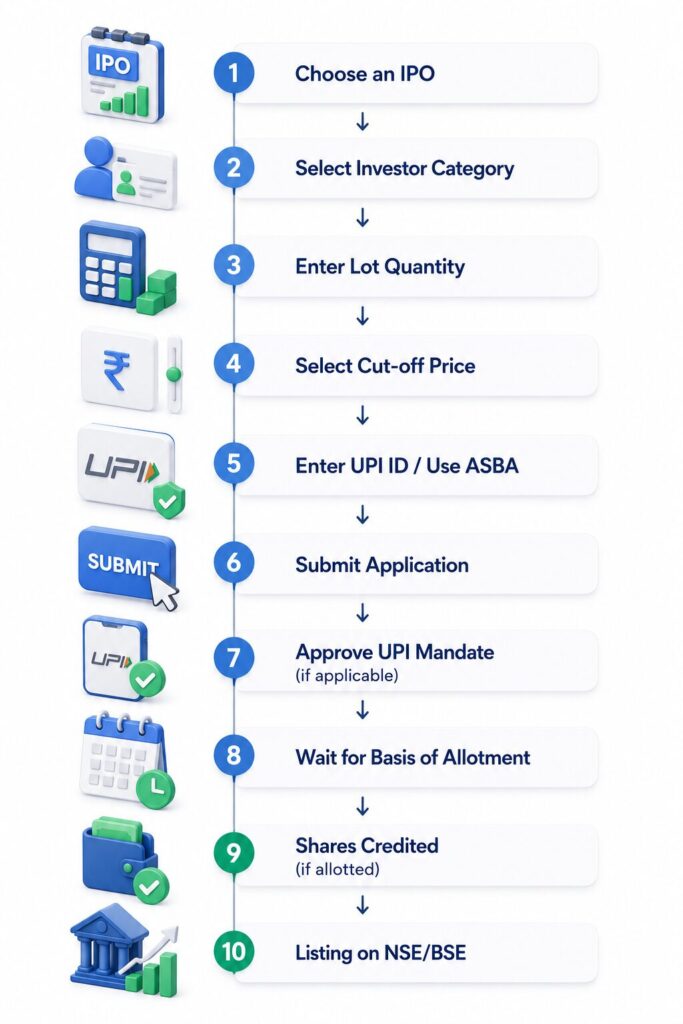
Step-by-Step Process
- Log in to your broker account.
- Open the IPO section.
- Select the IPO you want to apply for.
- Choose the Retail Investor category.
- Enter the number of lots.
- Select the Cut-off Price (recommended for retail investors).
- Enter your UPI ID.
- Submit the application.
- Approve the UPI mandate in your UPI app before the deadline.
Once the mandate is approved, the application is considered complete.
2. Apply Through Net Banking (ASBA)
Many banks allow investors to apply directly through their internet banking portal using the ASBA (Application Supported by Blocked Amount) facility.
Popular banks offering ASBA include:
Steps
- Log in to your internet banking account.
- Navigate to the IPO or ASBA section.
- Select the IPO.
- Enter your Demat details.
- Choose the investor category.
- Enter the lot quantity.
- Confirm your application.
Instead of debiting the money immediately, the bank blocks the required amount in your account until the allotment process is completed.
Investors learning how to apply for an IPO should also understand how ASBA works.
ASBA (Application Supported by Blocked Amount) is a SEBI-approved mechanism for IPO applications.
Under ASBA:
- Your application money remains in your bank account.
- The amount is only blocked.
- Funds are debited only if shares are allotted.
- If you do not receive an allotment, the blocked amount is released.
This system improves transparency and reduces unnecessary fund transfers. If you’re exploring how to apply for an IPO through net banking, understanding how ASBA works is essential, as it is the primary application method offered by most banks.
What is a UPI Mandate?
When applying through a broker, your bank sends a UPI mandate request.
Approving this mandate authorizes your bank to block the application amount.
Important: Simply submitting the IPO application is not enough. You must approve the UPI mandate before the specified deadline; otherwise, your application may become invalid.
The following guide explains how to apply for an IPO using both UPI and ASBA.
IPO Investor Categories Explained
| Category | Investment Limit |
|---|---|
| Retail Individual Investor (RII) | Up to ₹2 lakh |
| Small HNI (sNII) | Above ₹2 lakh to ₹10 lakh |
| Big HNI (bNII) | Above ₹10 lakh |
| Employee Category | Reserved for eligible employees (if applicable) |
| Shareholder Category | Reserved for eligible shareholders (if applicable) |
| Qualified Institutional Buyers (QIBs) | Institutional investors |
Each category has a separate allocation during the IPO process.
Should You Apply at the Cut-off Price?
For most retail investors, selecting the Cut-off Price is generally preferred.
When you choose the Cut-off Price, you agree to subscribe at the final issue price determined within the announced price band. This helps avoid the possibility of your application becoming ineligible because you bid below the final issue price.
How Many Lots Should You Apply For?
The minimum number of shares you can apply for is called one lot.
You may apply for multiple lots, provided the total application amount remains within the investment limit for your investor category.
Before applying, review the IPO prospectus to understand the lot size and applicable investment limits.
Common Mistakes to Avoid While Applying for an IPO
Many IPO applications are rejected due to avoidable errors.
Some common mistakes include:
- Entering an incorrect PAN number.
- Providing wrong Demat account details.
- Not approving the UPI mandate before the deadline.
- Having insufficient funds in the bank account.
- Applying after the IPO closing time.
- Entering incorrect bid details.
Double-checking your application before submission can help avoid these issues.
What Happens After You Apply?
Once the IPO closes, the registrar verifies all valid applications and finalizes the Basis of Allotment.
If you receive an allotment:
- Shares are credited to your Demat account before the listing date.
- The application amount is debited from your blocked funds.
If you do not receive an allotment:
- The blocked amount is released by your bank.
The company then lists its shares on the stock exchange, where investors can trade them. Knowing how to apply for an IPO is only the first step. Investors should also understand the allotment process, refund timelines, and listing schedule before investing in any public issue.
Tips for First-Time IPO Investors
- Read the company’s Red Herring Prospectus (RHP) before investing.
- Understand the company’s business model and financial performance.
- Apply well before the IPO closing time.
- Keep sufficient funds available until the allotment process is complete.
- Track important IPO dates such as allotment and listing.
- Invest only after assessing your financial goals and risk tolerance.
- If you’re new and learning how to apply for an IPO, consider starting with a single lot to understand the application and allotment process before making larger investments.
Conclusion
Applying for an IPO in India has become much simpler with the introduction of ASBA and UPI-based applications. Whether you choose to apply through your broker or via net banking, understanding the process can help you avoid common mistakes and complete your application smoothly.
Before investing, take time to understand the company’s business, financials, risks, and objectives. IPO investing should be approached as part of a broader investment strategy rather than focusing solely on listing-day performance.
By following the correct application process and staying informed, investors can participate in IPOs with greater confidence while making more informed investment decisions.
Know how to purchase shares of unlisted companies
Frequently Asked Questions (FAQs)
1. How to apply for an IPO in India?
You can apply for an IPO through a registered stock broker using the UPI-based process or via your bank’s ASBA (Application Supported by Blocked Amount) facility. Before applying, ensure you have a PAN card, Demat account, trading account, bank account, and sufficient funds.
2. What documents are required to apply for an IPO?
To apply for an IPO, you typically need:
- PAN Card
- Demat Account
- Trading Account
- Bank Account
- UPI ID (for UPI-based applications)
- Sufficient funds in your bank account
3. What is ASBA in an IPO?
ASBA (Application Supported by Blocked Amount) is a SEBI-approved mechanism that blocks the IPO application amount in your bank account instead of debiting it immediately. The amount is deducted only if shares are allotted to you.
4. Should I apply at the Cut-off Price?
For most retail investors, selecting the Cut-off Price is generally recommended. It allows your application to be considered at the final issue price determined within the IPO price band.
5. Can I apply for the same IPO from multiple Demat accounts?
No. You should not submit multiple IPO applications using the same PAN, even if you have multiple Demat accounts. Only one application per PAN is allowed in the Retail Individual Investor (RII) category, and duplicate applications may be rejected.
6. Can family members apply for the same IPO?
Yes. Each eligible family member can apply separately using their own PAN, Demat account, bank account, and UPI ID. Each application is treated independently.
7. What happens if I don’t approve the UPI mandate?
If you fail to approve the UPI mandate before the specified deadline, your IPO application may become invalid and will not be considered for allotment.
8. When is the IPO application amount deducted?
Your application amount is blocked when you apply for the IPO. It is debited only if shares are allotted. If you do not receive an allotment, the blocked amount is released by your bank.
9. How can I check my IPO allotment status?
You can check your IPO allotment status on the IPO registrar’s website or through the BSE or NSE IPO allotment portals using your PAN, application number, or Demat account details.
10. Can I modify or cancel my IPO application?
Yes. You can usually modify or withdraw your IPO application during the IPO bidding period through your broker or bank. Once the issue closes, changes are generally not permitted.
11. What is the minimum investment required to apply for an IPO?
The minimum investment depends on the lot size and issue price of the IPO. Investors must apply for at least one lot, and the minimum application amount varies from one IPO to another.
12. Is IPO allotment guaranteed after applying?
No. Applying for an IPO does not guarantee allotment. If an IPO is oversubscribed, shares are allotted based on the applicable allotment process. In the retail category, allotment is generally conducted through a computerized lottery system when demand exceeds the available shares.
13. Can I apply for an IPO without a Demat account?
No. A Demat account is mandatory to receive shares allotted in an IPO. Without a Demat account, you cannot apply for an IPO in India.
14. Can I apply for an IPO using any UPI app?
Yes, provided your UPI app and bank support IPO mandates. You must enter a valid UPI ID and approve the mandate request before the deadline for your application to be considered.
15. Is there any fee for applying for an IPO?
No, brokers and banks generally do not charge a separate fee for submitting an IPO application. However, you should always check with your broker or bank for any applicable charges or conditions.
These FAQs are designed to answer common investor questions while naturally reinforcing the focus keyword “How to Apply for an IPO” and related search queries, supporting both user experience and SEO.
16. How to apply for an IPO through UPI?
To apply for an IPO through UPI, log in to your stock broker’s app or website, select the IPO you wish to apply for, choose the Retail Investor category, enter the number of lots, select the Cut-off Price, and provide your UPI ID. After submitting the application, you must approve the UPI mandate request in your preferred UPI app before the deadline. Once approved, your application amount is blocked in your bank account and will be debited only if you receive an IPO allotment.