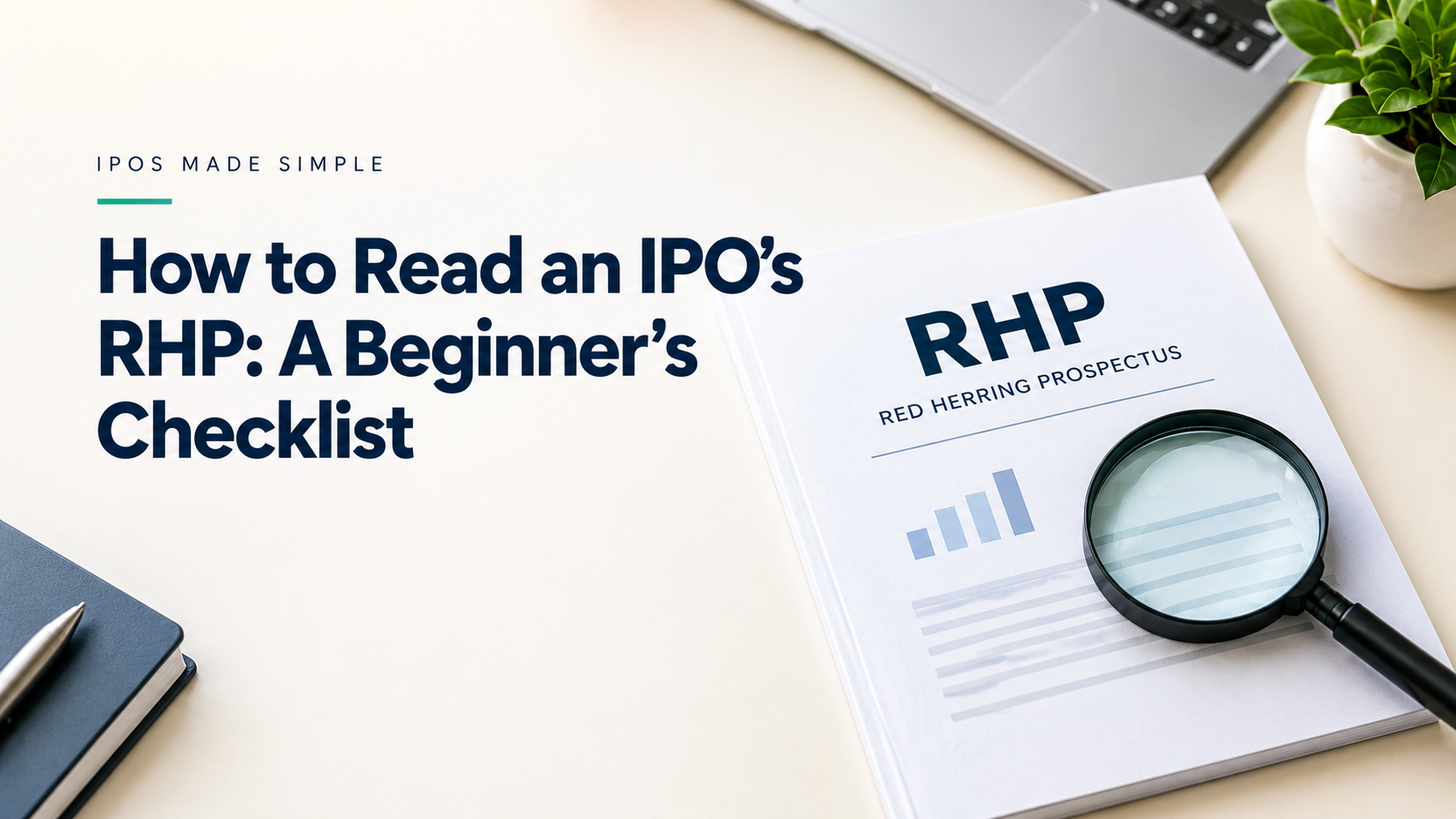
How to Read an IPO’s RHP: A Beginner’s Checklist
An IPO prospectus can look intimidating when you first open it. Hundreds of pages, financial tables, legal disclosures and unfamiliar terms can make it difficult to understand what a company is offering and what you might be getting into as an investor.
But you do not need to read every page to understand the essentials.
A Red Herring Prospectus (RHP) contains important information about a company planning to go public, including its financial performance, business risks, promoters, IPO structure and the proposed use of funds. Learning how to read it can help you make a more informed decision before applying for an IPO.
This guide explains how to read an IPO’s RHP in India, how it differs from a Draft Red Herring Prospectus (DRHP), which sections deserve the most attention and how to use a practical checklist to assess an upcoming public issue.
Learn How to Apply for an IPO
Investors unfamiliar with the IPO application process can refer to our guide on How to Apply for an IPO before submitting an application.
What Is an RHP, and Why Should IPO Investors Read It?
A Red Herring Prospectus, or RHP, is an official document that provides detailed information about a company planning to raise money from the public through an initial public offering (IPO).
It includes details about the company’s business model, financial performance, outstanding borrowings, legal proceedings, promoter shareholding, risk factors and the purpose of the issue.
Think of it as a company’s detailed disclosure document. It helps you look beyond the headlines, brand recognition and expected listing gains to understand the business you may be investing in.
In India, the RHP is generally filed before the IPO opens for subscription. It is available through official regulatory, stock exchange and issuer channels.
Why does it matter? An IPO application is an investment decision. Reading the RHP helps you assess whether the company’s financial position, business risks and valuation justify the price being asked for its shares.
DRHP vs RHP: What Is the Difference?
The Draft Red Herring Prospectus (DRHP) and the Red Herring Prospectus (RHP) serve different purposes in the IPO process.
DRHP (Draft Red Herring Prospectus)
- Filed earlier in the IPO process.
- Contains preliminary disclosures about the company’s business, financials, risks and proposed offer.
- May not contain the final price band or all finalised offer details.
- Helps investors understand the company before the IPO reaches the subscription stage.
RHP (Red Herring Prospectus)
- An updated offer document issued before the IPO opens.
- Includes updated disclosures and more finalised details about the offer.
- Generally provides the price band and relevant issue information in the offer documentation.
- Helps investors review the offer before making an application.
The RHP may still be followed by a final prospectus and other updates. Therefore, investors should not assume that every offer detail is final simply because the RHP has been published.
Beginner’s tip: If you have already read the DRHP, do not automatically rely on it when the IPO opens. Read the RHP and check for addenda, corrigenda or other updates that may change important details.
For more information, refer to SEBI’s official website and its public issue disclosures.
How to Find an IPO’s Official RHP
Avoid relying entirely on screenshots, social media posts or third-party summaries. Start with the primary document.
You can access offer documents through the following sources:
- SEBI’s Public Issues page: https://www.sebi.gov.in/filings/public-issues.html
- NSE’s Public Offer Documents page: https://www.nseindia.com/static/products-services/public-offer-documents
- BSE’s official website: https://www.bseindia.com/
- The company’s official IPO or investor-relations webpage.
A practical example: Visit NSE’s offer-document listings and look for a company that has filed its IPO documents. Compare the DRHP, RHP and any subsequent updates available for that company. This helps you understand how disclosures evolve throughout the IPO process.
When examining a document, confirm the company name, filing date and document type. An older DRHP may not contain the latest information.
The Beginner’s Checklist: Seven Sections to Read First
An RHP can run into hundreds of pages. You do not have to read it from beginning to end in your first sitting.
Start with these seven sections.
1. Objects of the Issue: Where Is the Money Going?
The Objects of the Issue section explains why the company is raising money and how the proceeds are expected to be used.
An IPO can include two broad components:
Fresh issue: The company issues new shares and receives the proceeds, subject to the stated expenses and terms.
Offer for sale (OFS): Existing shareholders sell some of their shares. The sale proceeds go to those selling shareholders, not to the company.
An IPO can contain both components.
For example, imagine a hypothetical ₹1,000 crore IPO consisting of a ₹600 crore fresh issue and a ₹400 crore OFS. The company would receive the fresh-issue proceeds, less applicable expenses, while the selling shareholders would receive the OFS proceeds, less applicable expenses.
This distinction matters because the size of an IPO does not tell you how much new capital the company will receive.
Look for proposed uses such as:
- Repayment or prepayment of borrowings.
- Capital expenditure, including new factories or equipment.
- Working capital requirements.
- Acquisitions or strategic investments.
- General corporate purposes.
What should you ask? Will the proposed spending help the company improve its operations, expand profitably or strengthen its balance sheet? Or is a substantial part of the offer simply allowing existing investors to sell their holdings?
Neither a fresh issue nor an OFS is automatically good or bad. The reason behind the transaction matters.
2. Risk Factors: What Could Go Wrong?
The Risk Factors section is among the most important parts of an RHP. It identifies risks that could affect the company’s business, profitability, operations or share price.
Start by looking for risks specific to that company rather than treating every disclosure as equally important.
Common examples include:
- Dependence on a small number of customers.
- Reliance on a particular supplier or raw material.
- High debt or substantial interest expenses.
- Ongoing litigation or regulatory proceedings.
- Geographic concentration or exposure to one industry.
- Losses, cash-flow pressure or dependence on external funding.
- Uncertainty around licences, approvals or contracts.
Suppose a company earns a large share of its revenue from two customers. Losing either customer could materially affect its performance. That risk deserves more attention than a general statement that competition may increase.
Similarly, if a business depends heavily on imported raw materials, currency movements and changes in global prices could affect margins.
What should you ask? How likely is the risk to materialise, how serious would its impact be, and does the company have a credible way to manage it?
Do not treat the presence of a risk factor as proof of wrongdoing. These disclosures are intended to inform investors about material uncertainties. Read the details and distinguish routine business risks from those that could fundamentally weaken the investment case.
3. Promoter Holding: Who Owns the Company?
Promoters are the individuals or entities identified as having promoted the company and, in many cases, having a significant role in controlling it.
The RHP typically discloses shareholding before and after the issue, along with information about promoters, other shareholders and relevant lock-in arrangements.
Pay attention to:
- Promoter shareholding before the IPO.
- Expected promoter shareholding after the IPO.
- Shares being sold by promoters, if any.
- Shares held by private equity or venture capital investors.
- Pledged shares, where applicable.
- Lock-in requirements and their applicable timelines.
A reduction in promoter ownership is not automatically a warning sign. It could reflect a partial exit, diversification or the structure of the transaction. The key question is how much ownership remains and whether the post-IPO ownership structure aligns with your expectations.
Also, a promoter retaining a large stake does not guarantee that the company will perform well.
What should you ask? Are existing shareholders selling a substantial part of their holdings? How much ownership remains with promoters? Are there material governance, litigation or related-party concerns disclosed elsewhere in the document?
4. Financial Statements: Is the Business Improving?
Find the audited financial statements and read the company’s results for the periods presented in the RHP.
Focus on five basic indicators:
Revenue: How much the company earns from its operations.
Profit after tax (PAT): What remains after expenses, interest and taxes.
Operating cash flow: Whether operations generate cash.
Borrowings: How much debt the company carries.
Earnings per share (EPS): Profit attributable to each share, based on the relevant share count.
Look for trends rather than relying on one strong year.
Revenue growth without corresponding improvement in profitability may indicate rising costs or pricing pressure. Profit growth alongside persistently weak operating cash flow deserves further investigation.
Also check whether the business has reported losses in earlier periods, whether borrowings have increased and whether exceptional items materially affect reported profit.
For a fair assessment, consider the company’s industry and stage of development. A young growth company may have a different financial profile from an established, profitable manufacturer.
5. Valuation: Is the IPO Price Reasonable?
A promising business is not necessarily an attractive investment at every price.
The RHP and related offer documents provide information that can help you assess valuation, including earnings, share capital, the price band and key performance indicators where disclosed.
Start with the price-to-earnings (P/E) ratio if the company has meaningful positive earnings.
P/E ratio = Market price per share ÷ Earnings per share
Compare the company’s valuation with listed peers, but make sure they have reasonably comparable business models, growth rates, profitability and debt levels.
A company growing faster than its peers may justify a premium in some circumstances. However, a high valuation also leaves less room for disappointment.
If the company is loss-making, the P/E ratio may be meaningless. You may need to examine other measures, such as price-to-sales, enterprise value to EBITDA or industry-specific operating metrics, depending on the business.
What should you ask? What assumptions about future growth and profitability are already reflected in the IPO price? Would the investment still look attractive if growth were slower than expected?
6. Use of Proceeds: Does the Spending Plan Make Sense?
Although the Objects of the Issue section explains why the company is raising money, the detailed disclosures about the use of proceeds help you understand the proposed allocation.
Look for the amount allocated to each purpose and whether the company has explained the rationale.
For example, debt repayment could reduce interest costs and improve financial flexibility. However, it does not automatically make a company a stronger business. You should still understand why the debt accumulated and whether operating performance can support future obligations.
Likewise, expansion spending can create opportunities but also introduces execution risks, construction delays and the possibility that new capacity will not generate the expected returns.
Check whether the company has outlined the project costs, implementation timeline and expected benefits. Where relevant, examine the role of intermediaries and the basis for estimated expenditure.
The objective is not to judge a stated purpose in isolation. It is to decide whether the capital allocation plan is credible and consistent with the company’s long-term business strategy.
7. Litigation, Related-Party Transactions and Management
Before applying, review the disclosures concerning material legal proceedings, outstanding regulatory matters, related-party transactions and the company’s directors and key managerial personnel.
Related-party transactions are dealings between the company and connected persons or entities, such as promoters or other group companies. Such transactions are not inherently improper, but their terms and scale matter.
Check whether the company has substantial transactions with promoter-linked entities, whether it depends on group companies for key operations, and whether material disputes could affect its financial position or reputation.
Also examine the qualifications and experience of its leadership, auditor-related disclosures and any material governance concerns.
A company can have strong revenue growth and still present significant governance or execution risks. Assess the complete picture rather than relying on one attractive financial metric.
A Practical IPO RHP Checklist
Before submitting an IPO application, make sure you can answer these questions:
- Have I opened the latest RHP and checked its filing date?
- Do I understand the fresh issue and OFS components?
- Do I know how the company plans to use the money?
- Have I identified the three most important company-specific risks?
- Have I reviewed promoter holdings and post-issue ownership?
- Have I checked revenue, profit, borrowings and operating cash flow?
- Have I compared the valuation with relevant listed peers?
- Have I reviewed material litigation and governance disclosures?
- Have I considered whether the potential return justifies the risks?
Completing this checklist will not guarantee a successful investment. It will, however, help you ask better questions and avoid relying solely on IPO popularity, subscription figures or expected listing gains.
For more background, explore SEBI’s investor education resources and its book-building explainer.
Investor Takeaway: What Should You Watch Next?
After reading the RHP, focus on three questions.
Business quality: Does the company have a credible business model, sustainable profitability and manageable risks?
Capital allocation: Will the IPO proceeds strengthen the business, and are existing shareholders selling a substantial stake?
Valuation: Is the asking price reasonable compared with the company’s financial performance, growth prospects and listed peers?
Also check the final offer documents, price band, subscription dates and any subsequent corrections before applying.
An IPO should not be judged solely by the possibility of listing gains. The RHP helps you assess the underlying business and the risks you would take by owning its shares.
For beginners, the most useful approach is simple: understand the business, examine the risks, follow the money and assess the price. You do not need to understand every technical term to make a more informed decision.
FAQs
1. Is reading the RHP compulsory before applying for an IPO?
It is not a compulsory step for submitting an application, but it is a valuable part of investment research. Reading the RHP helps you understand the company’s financial position, risks, ownership and proposed use of funds.
2. What is the difference between a DRHP and an RHP?
A DRHP is the draft offer document filed earlier in the IPO process. The RHP is an updated offer document issued before the IPO opens, with further details about the offer. Investors should check the latest RHP and subsequent updates rather than relying only on the draft.
3. Where can I download an IPO’s RHP in India?
You can look for it on SEBI’s Public Issues page, the NSE offer-documents page, BSE’s official website or the company’s IPO webpage.
4. Why is the Objects of the Issue section important?
It explains how the company intends to use the money raised. It also helps investors distinguish a fresh issue, in which the company receives the proceeds, from an OFS, in which existing shareholders sell their shares.
5. What are the most important sections of an RHP for beginners?
Start with the business overview, Objects of the Issue, Risk Factors, financial statements, promoter shareholding, valuation-related disclosures and material litigation. These sections provide a useful foundation for understanding the investment.
6. Does a SEBI-reviewed RHP mean an IPO is safe?
No. Regulatory review does not guarantee the company’s financial performance, the IPO’s valuation or investment returns. Investors remain exposed to market, business, financial and governance risks.
7. Can an IPO with strong subscription numbers still be a poor investment?
Yes. High subscription can indicate strong demand, but it does not establish that the company’s shares are attractively priced or that the business will perform well over time. Investors should evaluate the fundamentals and valuation independently.
Disclaimer
This article is for educational and informational purposes only and should not be construed as investment advice, a recommendation to subscribe to an IPO, or a solicitation to buy or sell securities. IPO investments carry market, business, valuation and liquidity risks, and investors may lose money. Readers should review the latest official offer documents, assess their financial circumstances and risk tolerance, and consult a qualified financial adviser where appropriate. Regulatory review of an offer document does not guarantee investment returns.