
How Does the Stock Market Work in India? A Practical Guide for Beginners
If you are new to investing, understanding the stock market can feel confusing at first. You may have heard terms such as shares, stock exchanges, Demat accounts and trading accounts, but how do these things actually work together?
In our earlier article, What Is the Stock Market? A Beginner’s Guide to India, we explained the fundamentals of the stock market, including shares, stock exchanges and why companies raise money from investors. This guide takes the next step by explaining how an individual participates in the market and how buying and selling shares actually works.
From opening the necessary accounts to understanding stock market orders, trading hours and transaction charges, here is what beginners should know about how the Indian stock market works.
How Does the Stock Market Work in India?
The stock market is a marketplace where buyers and sellers trade shares of publicly listed companies. In India, this trading primarily takes place through two recognised stock exchanges:
- National Stock Exchange (NSE)
- Bombay Stock Exchange (BSE)
Both exchanges operate electronic trading platforms that match buy and sell orders.
For example, suppose you want to purchase 10 shares of a company trading at ₹500 each. You place a buy order through your stockbroker. The broker sends the order to the exchange, where it is matched with a compatible selling order.
Once the transaction is executed, the shares are credited to your Demat account after the applicable processing and settlement procedures.
The process involves three important participants:
- Investor: The individual who wants to buy or sell shares.
- Stockbroker: The intermediary who provides access to the stock exchange.
- Stock exchange: The platform where buy and sell orders are matched.
Understanding these roles makes it easier to follow how the stock market functions in practice.
What Accounts Do You Need to Participate in the Stock Market?
To participate in regular delivery-based equity investing in India, you generally need three accounts:
- A savings bank account.
- A trading account.
- A Demat account.
Each performs a different function.
What Is a Demat Account?
A Demat account, short for dematerialised account, holds shares and other securities in electronic form.
Think of it as a digital locker for your investments. When you purchase shares for delivery, they are credited to your Demat account, where they remain until you sell or transfer them.
In India, two central depositories maintain electronic records of securities:
- NSDL (National Securities Depository Limited)
- CDSL (Central Depository Services Limited)
Investors access these depositories through intermediaries called Depository Participants (DPs).
What Is a Trading Account?
A trading account allows you to place buy and sell orders through a stockbroker registered with a recognised stock exchange.
For example, when you use a broker’s application to purchase 10 shares of a company, your trading account facilitates the transaction.
Demat Account vs Trading Account: What Is the Difference?
| Feature | Demat Account | Trading Account |
| Main purpose | Holds securities | Facilitates transactions |
| Used for | Storing shares electronically | Buying and selling shares |
| Managed through | Depository Participant | Stockbroker |
| Analogy | Digital locker | Transaction gateway |
How Do the Three Accounts Work Together?
Consider an example where you want to purchase 10 shares of a company.
- Your bank account provides the money required for the transaction.
- Your trading account allows you to place the buy order.
- Your stockbroker routes the order to the exchange.
- The exchange matches your order with a compatible seller.
- Once the transaction is completed and processed, the shares are credited to your Demat account.
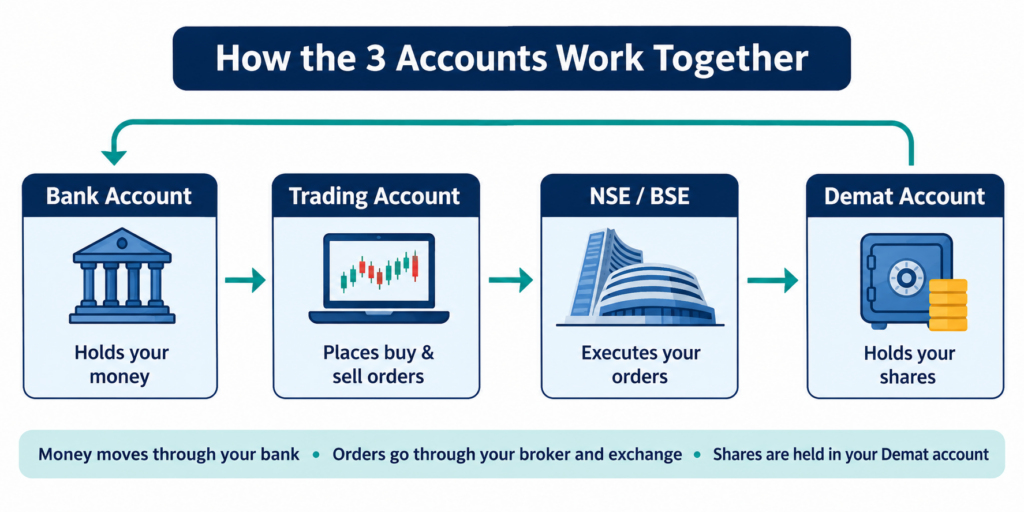
Illustration of how money, orders and shares move through the stock market transaction process.
How to Open a Demat and Trading Account in India
Most stockbrokers offer an online account-opening process.
The general steps include:
- Select a SEBI-registered stockbroker.
- Complete the online account-opening application.
- Provide your PAN and identity details.
- Complete the applicable KYC verification.
- Provide your bank account details and supporting documents.
- Complete the required verification formalities.
Once the account is activated, you can access the broker’s trading platform.
Before opening an account, understand the brokerage structure, annual maintenance charges, transaction fees and other applicable costs.
How Does Buying and Selling Shares Work?
Once your accounts are ready, the next step is understanding what happens when you purchase a share.
Let’s take a simple example.
Suppose Company ABC is trading at ₹500 per share and you want to purchase 10 shares.
Here is how the transaction works:
- Log in to your broker’s trading application.
- Search for Company ABC.
- Enter the quantity as 10 shares.
- Select the order type.
- Enter the price, if required.
- Submit your order.
- Your broker routes the order to the stock exchange.
- The exchange matches it with a compatible selling order.
- Once matched, the trade is executed.
- The transaction proceeds through the applicable settlement process.
Example of a share purchase:
| Particulars | Amount |
| Share price | ₹500 |
| Quantity | 10 |
| Total transaction value | ₹5,000 |
| Shares purchased | 10 |
The example excludes brokerage, taxes and other applicable charges.
An important distinction is that placing an order does not automatically mean the trade has been completed. The order must first be matched with a compatible order on the exchange.
What Are the Different Types of Stock Market Orders?
When buying or selling shares, investors encounter different types of orders. Each determines how the transaction is executed.
1. What Is a Market Order?
A market order instructs the exchange to execute a transaction at the best available market price.
For example, suppose a share is trading at ₹500. You place a market order to purchase 10 shares.
The order attempts to execute against the best available selling prices. However, the actual execution price may differ from ₹500, particularly when prices are moving quickly or the stock has limited trading activity.
This difference is commonly known as slippage.
2. What Is a Limit Order?
A limit order allows you to specify the maximum price you are willing to pay when buying a share or the minimum price you are willing to accept when selling.
For example:
- Current share price: ₹500
- Specified buying price: ₹490
Your buy order will execute only at ₹490 or lower, provided a matching seller is available.
If the market price does not reach your specified level, the order may remain pending or expire, depending on its validity.
Market Order vs Limit Order
| Feature | Market Order | Limit Order |
| Price | Best available price | Specified price or better |
| Price certainty | Not guaranteed | Controlled by the limit |
| Execution | Depends on available liquidity | Requires a matching order |
| Guaranteed execution? | No | No |
3. What Is a Stop-Loss Order?
A stop-loss order is activated when a specified trigger price is reached.
For example, suppose a share is trading at ₹500 and an investor sets a trigger price of ₹480.
When the relevant price condition is met, the order gets activated. Depending on the selected order type, it may become a market or limit order.
A stop-loss order does not guarantee execution at the trigger price. Market gaps and insufficient liquidity can affect the final execution price.
What Are the Stock Market Timings in India?
The Indian equity market operates primarily through NSE and BSE.
The standard timings for the regular equity market are:
| Session | Timings (IST) |
| Pre-open session | 9:00 AM – 9:15 AM |
| Regular trading session | 9:15 AM – 3:30 PM |
| Post-close session | 3:50 PM – 4:00 PM |
The regular equity market generally operates from Monday to Friday, excluding exchange-declared trading holidays.
The pre-open session helps determine the opening price through an order-matching mechanism. The post-close session follows separate exchange rules and is not the same as normal continuous trading.
Some securities and market segments may have different arrangements. Investors should check the applicable exchange calendar for holidays and special trading sessions.
What Is the Difference Between Delivery and Intraday Trading?
Another important distinction beginners should understand is the difference between delivery-based transactions and intraday trading.
Although both involve buying and selling shares, their holding periods and transaction characteristics differ.
What Is Delivery Trading?
In delivery-based trading, shares purchased are intended to be held beyond the trading session.
After the applicable settlement process, the shares are credited to the investor’s Demat account.
For example, if you purchase 10 shares of a company and continue holding them beyond the trading day, the transaction is treated as a delivery purchase.
The shares become part of your holdings.
What Is Intraday Trading?
Intraday trading involves opening and closing a position within the same trading day.
For example:
- Purchase price: ₹500
- Selling price: ₹510
- Quantity: 10 shares
- Difference before charges: ₹100
If the transaction is closed at ₹510, the gross difference is ₹100, before applicable costs and taxes.
Unlike delivery transactions, intraday trades do not result in shares being credited to your Demat account as retained holdings.
Delivery vs Intraday Trading
| Feature | Delivery Trading | Intraday Trading |
| Holding period | Beyond the trading day | Within the same trading day |
| Share ownership | Shares credited after settlement | No retained delivery holding |
| Demat account | Required for holding shares | Not generally used for the intraday position |
| Risk | Market and company-specific risks | Market volatility and execution risks |
Intraday trading can involve additional risks, including rapid price movements and leverage where applicable. Understanding this distinction is important before participating in either type of transaction.
What Are the Charges for Buying and Selling Shares in India?
The share price displayed on a trading application is not necessarily the total amount you pay.
Stock market transactions involve several charges, depending on the transaction type, broker and applicable regulations.
| Charge | What It Means |
| Brokerage | Fee charged by the stockbroker for executing transactions |
| STT | Securities Transaction Tax levied on specified securities transactions |
| Exchange transaction charges | Fees levied by the stock exchange |
| SEBI turnover fees | Regulatory fees based on transaction value |
| GST | Applicable tax on specified services and charges |
| Stamp duty | Government levy on specified securities transactions |
| DP charges | Applicable depository-related charges, commonly associated with selling delivery holdings |
The applicable charges can vary depending on the transaction, exchange, broker and prevailing regulations.
For instance, brokerage structures differ between brokers, while STT and stamp duty are governed by applicable rules.
It is therefore important to understand your contract note and transaction statement rather than looking only at the share price.
How to Understand Stock Market Prices and Indices
Once you access a broker’s trading platform, you will come across several numbers and indicators. Understanding their meaning helps you make sense of market movements.
What Is a Stock’s Market Price?
The market price represents the price at which a share is currently trading or the price of its most recent transaction.
However, the last traded price is not necessarily the price at which your next order will execute.
For example, a stock may display a last traded price of ₹500, while available buyers and sellers are quoting slightly different prices.
The difference between the best available buying price and selling price is called the bid-ask spread.
What Are Nifty 50 and Sensex?
Nifty 50 and Sensex are benchmark stock market indices that represent the performance of selected companies.
| Index | Stock Exchange | Number of Companies |
| Nifty 50 | NSE | 50 |
| Sensex | BSE | 30 |
These indices help investors understand the broader direction of the Indian equity market.
For example, if the Nifty 50 rises by 1%, it indicates that the index has gained 1% during the relevant period. It does not mean every stock in the index has risen by the same percentage.
Similarly, an individual stock can fall even when the broader market indices are rising.
What Should Beginners Know Before Participating in the Stock Market?
Before participating in the stock market, beginners should understand a few important principles:
- Understand the business: A share represents ownership in a company, not merely a changing price on a screen.
- Know the risks: Stock prices can fall because of company-specific developments, economic conditions or broader market sentiment.
- Understand transaction costs: Brokerage, taxes and other charges affect the final transaction value.
- Avoid unverified tips: Social media messages and promises of guaranteed returns should be treated with caution.
- Understand different products: Equity shares, ETFs, mutual funds and derivatives are different financial instruments with different characteristics and risks.
- Read official documents: Contract notes, account statements and exchange communications provide important transaction information.
SEBI advises investors to deal with registered intermediaries, understand applicable charges and avoid relying on unsolicited investment tips.
Its investor education and protection resources provide further information on these responsibilities.
Conclusion
Understanding how the stock market works in India involves more than knowing what shares and stock exchanges are.
Beginners should understand the roles of Demat and trading accounts, how stock orders are executed, the difference between delivery and intraday transactions, market timings and the charges involved.
These concepts provide the foundation for understanding how India’s equity market functions in practice.
The stock market offers an opportunity to participate in businesses, but it also involves financial risks. A clear understanding of the processes, costs and responsibilities involved is an important first step towards becoming an informed market participant.
FAQs
1. How can a beginner start investing in the stock market in India?
A beginner generally needs a savings bank account, a Demat account and a trading account with a SEBI-registered stockbroker. After completing the applicable KYC and account activation process, the individual can access the stock market through the broker’s platform.
2. Can I buy shares without a Demat account?
For regular delivery-based equity investing, a Demat account is required to hold shares electronically. Certain trading arrangements, such as intraday transactions, may not require shares to be credited to a Demat account as retained holdings.
3. What is the minimum amount required to invest in the stock market?
There is no universal minimum investment amount for buying listed equity shares. The amount depends on the share price, quantity purchased and applicable transaction charges. The minimum amount for other investment products may differ.
4. What is the difference between NSE and BSE?
NSE and BSE are India’s two major stock exchanges. NSE operates the Nifty 50 index, while BSE operates the Sensex. Both provide electronic platforms for trading listed securities.
5. What is the difference between a market order and a limit order?
A market order seeks execution at the best available price, whereas a limit order specifies the maximum buying price or minimum selling price acceptable to the investor. Neither order type guarantees execution.
6. What is the difference between delivery and intraday trading?
Delivery trading involves holding purchased shares beyond the trading session, with the shares credited to the investor’s Demat account. Intraday trading involves opening and closing a position within the same trading day.
7. Is the Indian stock market open every day?
No. The regular equity market generally operates Monday to Friday, excluding Saturdays, Sundays and exchange-declared holidays. Special trading sessions, such as Muhurat Trading, may be announced separately.
8. Are stock market returns guaranteed?
No. Stock market returns are not guaranteed. Share prices can rise or fall, and investors may lose part or all of their invested capital.
Disclaimer
This article is intended solely for educational and informational purposes. It does not constitute investment advice, a recommendation to buy or sell securities, or a solicitation to participate in any financial product. Stock market investments are subject to market risks. Readers should understand the relevant risks, regulations, transaction costs and product features before making financial decisions.