
What Is the 3-5-7 Rule in Stock Trading?
Disclaimer: This article is strictly for educational and informational purposes. It does not constitute investment advice or recommend buying, selling or holding any particular stock. Stock market trading involves financial risk, including the potential loss of capital.
Most people enter the stock market thinking about one thing: how much money they can make.
But experienced traders know that there’s another question that’s just as important: How much money can I afford to lose if a trade doesn’t go as planned?
This is where risk management comes in.
One framework that has gained attention among traders is the 3-5-7 rule in stock trading. It offers a simple way to think about how much capital to risk on an individual trade, how much risk to take across multiple open positions and how to approach winning trades.
Let’s understand what the 3-5-7 rule means, how it works with practical examples and whether it is suitable for beginners.
What Is the 3-5-7 Rule in Stock Trading?
The 3-5-7 rule is an informal risk-management framework that uses three numbers to encourage disciplined trading.
A commonly discussed interpretation consists of:
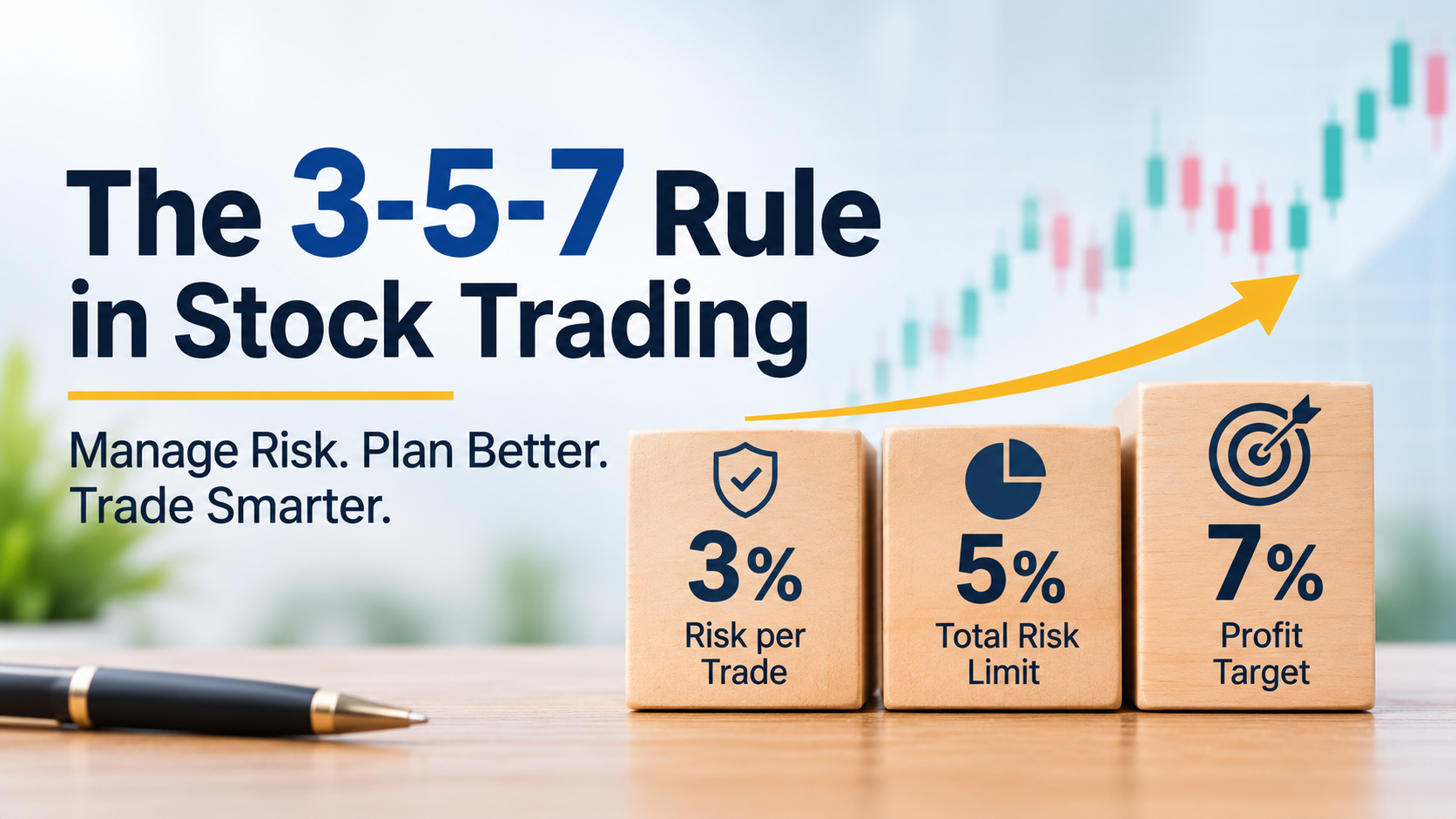
- 3%: Limit the planned risk on a single trade to 3% of your trading capital.
- 5%: Keep the combined planned risk across all open positions within 5% of your trading capital.
- 7%: Aim for average winning trades to be at least 7% larger than average losing trades.
The underlying idea is simple: limit the damage from individual losing trades, avoid excessive exposure across multiple positions and ensure that winning trades are large enough to help offset losses.
It is important to note that the 3-5-7 rule is not a standardised industry formula or a SEBI-prescribed trading rule. Different trading educators interpret the third number differently. Some describe it as a 7% profit target, while others use it as a reward-to-risk guideline.
For this article, we follow the interpretation that the average winning trade should be at least 7% larger than the average losing trade.
Breaking Down the 3-5-7 Rule
1. The 3% Rule: Limit Your Risk on a Single Trade
The first component suggests that you should not risk more than 3% of your trading capital on an individual trade.
Here’s something important to understand: This does not mean you can invest only 3% of your money in a stock.
It means that if your stop-loss is triggered, the planned loss should ideally remain within 3% of your trading capital.
Let’s take an example.
Suppose you have a trading account of ₹5 lakh.
Three per cent of ₹5 lakh is ₹15,000.
This means your planned loss on a single trade should not exceed ₹15,000 if your stop-loss is triggered.
Consider the following hypothetical trade:
- Trading capital: ₹5,00,000
- Stock entry price: ₹500
- Stop-loss price: ₹485
- Risk per share: ₹15
- Maximum planned loss: ₹15,000
To calculate the number of shares:
₹15,000 ÷ ₹15 = 1,000 shares.
You could therefore take a position of 1,000 shares at ₹500, amounting to ₹5 lakh.
If the stock falls to ₹485 and your stop-loss executes at that price, your planned loss would be ₹15,000, excluding brokerage, taxes, other charges and slippage.
The takeaway? Your position size should depend on how much you are willing to lose, not simply on how much money you have available.
2. The 5% Rule: Keep Overall Trading Risk Under Control
What happens when you have multiple open trades?
Imagine you have identified three stocks that appear attractive from a technical perspective. Each trade individually follows the 3% rule.
However, if all three trades move against you, your combined losses could become significantly larger.
That’s what the 5% rule attempts to address.
It suggests keeping the combined planned risk across all open positions within 5% of your trading capital.
Let’s continue with our ₹5 lakh example.
Five per cent of ₹5 lakh is ₹25,000.
This means the combined potential loss across your open trades should ideally not exceed ₹25,000 if all your stop-losses are triggered.
Consider this situation:
- Trade A: Potential loss of ₹8,000
- Trade B: Potential loss of ₹7,000
- Trade C: Potential loss of ₹6,000
Total planned risk = ₹21,000.
Your combined risk is currently 4.2% of your trading capital, leaving ₹4,000 of room within the illustrative 5% limit.
However, there’s another important consideration: correlation.
For example, holding positions in three different banking stocks does not necessarily mean you have diversified your risk. If the banking sector experiences a sharp correction, all three positions could decline together.
Therefore, traders should consider how their open positions might react to the same market event.
3. The 7% Rule: Make Winning Trades Count
The third component focuses on the relationship between winning and losing trades.
Under the interpretation used here, the average winning trade should be at least 7% larger than the average losing trade.
Let’s understand this with an example.
Suppose a trader’s average loss is ₹1,000.
A winning trade that is 7% larger would generate:
₹1,000 + 7% of ₹1,000 = ₹1,070.
In this example:
- Average losing trade: ₹1,000
- Average winning trade: ₹1,070
The idea is to ensure that winning trades are not consistently smaller than losing trades.
However, this does not mean that a trader will automatically become profitable by following this guideline.
The number of winning trades, number of losing trades, brokerage, taxes, slippage and overall trading strategy all matter.
For example, even if your average winning trade is larger than your average losing trade, a very low win rate could still result in an overall loss.
This is why traders should look at the complete performance of their strategy rather than focusing on one percentage.
A note on different interpretations: Some sources describe the 7 as a 7% profit target, while others discuss different reward-to-risk interpretations. There is no universally accepted definition. It is important to understand which version is being followed instead of mixing different approaches.
How Does the 3-5-7 Rule Work in Practice?
Let’s put the three components together.
Assume a trader has ₹5 lakh in trading capital.
| Component | Percentage | Amount |
| Maximum planned risk per trade | 3% | ₹15,000 |
| Combined planned risk across open trades | 5% | ₹25,000 |
| Average winning trade compared with average losing trade | 7% higher | Depends on average loss |
The framework encourages traders to answer three questions before entering a trade:
- How much can I lose on this individual trade?
- How much am I already risking across my other open positions?
- Is my potential reward sufficient in relation to my expected loss?
These questions encourage traders to plan their trades rather than make decisions based on excitement, market rumours or fear of missing out.
Is the 3-5-7 Rule Suitable for Beginners?
An absolute beginner? Read our easy to understand Guide on the Stock Market
The framework can be a useful starting point because it encourages three important habits: controlling individual losses, monitoring overall exposure and paying attention to the relationship between wins and losses.
However, beginners should be careful about treating 3% as a target risk.
For someone with limited trading experience, risking 3% of capital on every trade can be aggressive.
Consider this example:
If you start with ₹5 lakh and lose 3% of your remaining capital on five consecutive trades, your account would fall to approximately ₹4.29 lakh.
That’s a reduction of around 14.1%.
This is why some traders prefer more conservative per-trade risk limits, such as 0.5% or 1%, depending on their strategy and risk tolerance.
The right number is not necessarily the one mentioned in a popular trading framework. It is the one that allows you to withstand losses without putting your overall financial position under pressure.
Limitations of the 3-5-7 Rule
Like any trading framework, the 3-5-7 rule has limitations.
1. It does not guarantee profits: Following risk limits cannot make an unsuccessful trading strategy profitable.
2. Stop-loss execution is not guaranteed at the exact price: During sharp market movements or periods of low liquidity, execution can happen at a different price.
3. Market volatility matters: A fixed percentage may not be suitable for every stock, trading style or market condition.
4. Correlated positions can increase risk: Different stocks may react similarly to the same market development.
5. The 7% interpretation is not universal: Traders should understand which version of the framework they are applying rather than mixing different interpretations.
What Should Traders Remember?
The biggest lesson from the 3-5-7 rule is that successful trading is not just about finding stocks that can go up.
It is also about knowing what to do when a trade goes against you.
A trading plan should account for position sizing, stop-losses, overall exposure and realistic profit expectations before an order is placed.
The 3-5-7 rule offers a memorable way to think about these decisions. But it should be treated as an educational framework, not a guaranteed formula for making money in the stock market.
After all, protecting your trading capital is just as important as trying to grow it.
Frequently Asked Questions (FAQs)
1. What is the 3-5-7 rule in stock trading?
The 3-5-7 rule is an informal risk-management framework. It commonly suggests limiting risk on an individual trade to 3%, keeping combined risk across open positions within 5% and ensuring average winning trades are at least 7% larger than average losing trades.
2. Is the 3-5-7 rule approved by SEBI?
No. The 3-5-7 rule is not an official SEBI regulation or mandatory trading guideline. It is an informal framework discussed in trading education.
3. Can beginners use the 3-5-7 rule?
Yes, beginners can study it to understand risk management and position sizing. However, risking 3% of capital on every trade can be aggressive. More conservative limits may be appropriate for inexperienced traders.
4. What does the 3% rule mean in trading?
It means limiting the planned loss on an individual trade to 3% of your trading capital if the stop-loss is triggered. It does not mean investing only 3% of your capital in a stock.
5. What does the 5% rule mean?
It suggests keeping the combined planned risk across all open positions within 5% of trading capital. This helps prevent excessive exposure to multiple trades.
6. What does the 7% rule mean?
In the interpretation used in this article, it means that average winning trades should be at least 7% larger than average losing trades. Other sources use different interpretations, including a 7% profit target.
7. Does the 3-5-7 rule guarantee profits?
No. It is a risk-management framework, not a profit-generating strategy. Market conditions, trading decisions, transaction costs and execution quality all influence trading results.
8. Can the 3-5-7 rule be used for intraday trading?
Its risk-management principles can be considered for intraday trading, swing trading and other trading styles. However, position sizes, stop-losses and profit expectations need to be adapted to the trading timeframe and market volatility.
Editorial References and Further Reading
The following sources provide additional explanations of the 3-5-7 framework and the underlying risk-management concepts:
- ET Now – 3-5-7 Rule in Stocks: What It Is and How It Works
- TMGM – What Is the 3-5-7 Rule in Forex?
- Zerodha Varsity – Position Sizing for Stock Trading
- Zerodha Varsity – Accepting and Reducing Risk
- Investor.gov – Stop, Stop-Limit and Trailing Stop Orders
Disclaimer
This article is published strictly for educational and informational purposes. It does not constitute investment advice, financial advice or a recommendation to buy, sell or hold any security. No specific stocks are being recommended. Stock market trading involves market risk, including the potential loss of capital. Readers should conduct their own research and consult a SEBI-registered investment adviser where appropriate before making financial decisions.