United Fidelity Bank Failure: Why It Was Shut Down and What Happens to Depositors
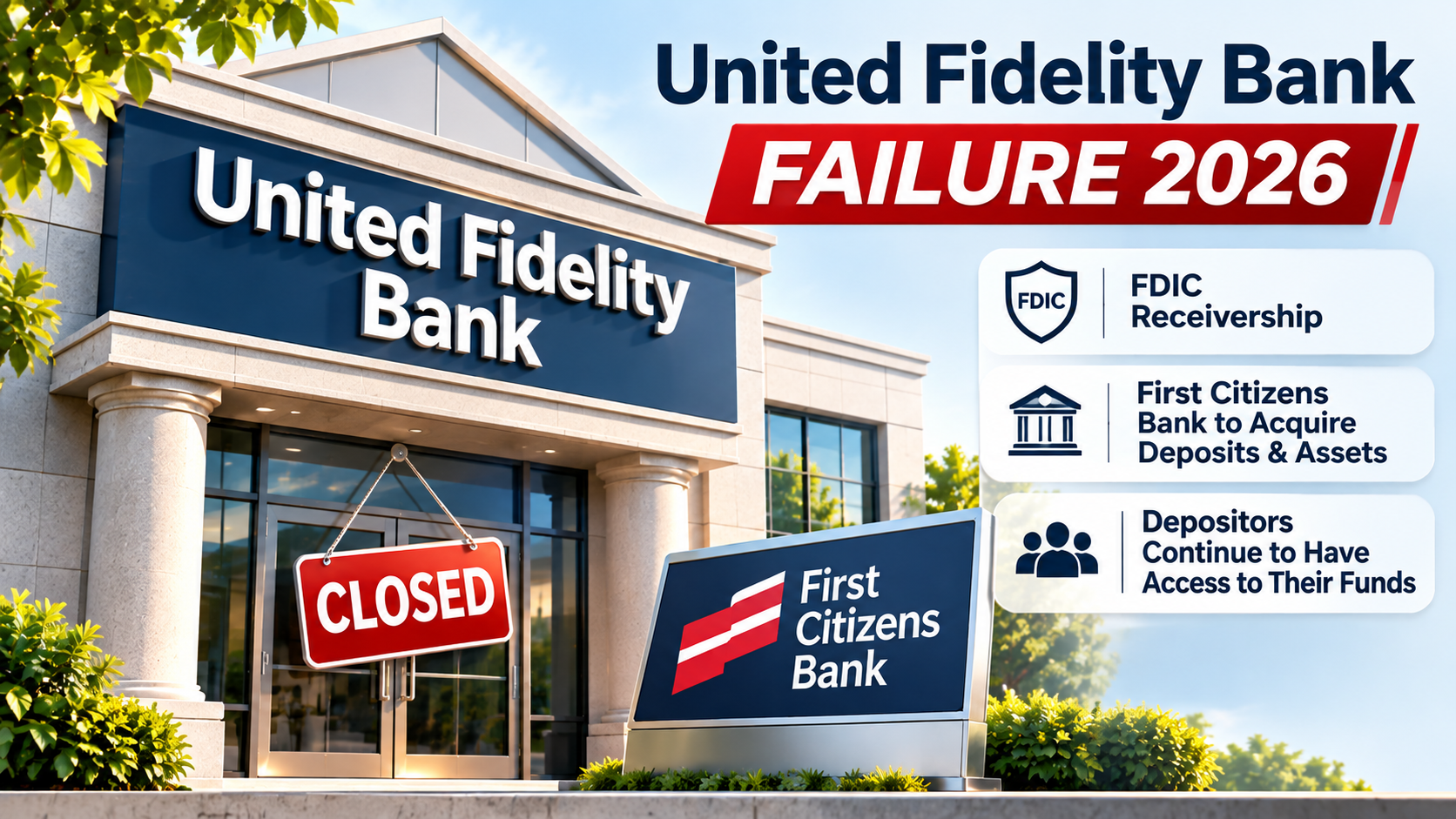
United Fidelity Bank, FSB, an Indiana-based lender with approximately $5.9 billion in assets, was closed by federal regulators on November 27, 2026. The Federal Deposit Insurance Corporation (FDIC) was appointed receiver, and First-Citizens Bank & Trust Company agreed to acquire substantially all of the failed bank’s assets and assume most of its deposits.
The closure marks the largest U.S. bank failure since Republic First Bank was shut down in April 2024. It also brings renewed attention to the financial condition of regional and community banks, regulatory oversight and the protection available to depositors when a financial institution fails.
For United Fidelity customers, the immediate message from regulators is reassuring: depositors will become customers of First Citizens Bank, and the FDIC says they will retain their funds and deposit insurance coverage. Customers can continue accessing their money through existing checks, debit cards and ATMs while the transition takes place.
However, the circumstances surrounding the failure raise important questions. United Fidelity had been subject to regulatory enforcement actions since 2023, including requirements involving capital planning, risk management, liquidity and corporate governance.
So, why did United Fidelity Bank fail? What did regulators identify before its closure? How much will the failure cost the FDIC? And what should customers do now?
Here is a detailed look at the United Fidelity Bank failure, the First Citizens acquisition and what it means for depositors and the U.S. banking sector.
United Fidelity Bank Failure: Key Details
| Detail | Information |
|---|---|
| Bank | United Fidelity Bank, FSB |
| Headquarters | Evansville, Indiana |
| Closure date | November 27, 2026 |
| Closing regulator | Office of the Comptroller of the Currency (OCC) |
| Receiver | Federal Deposit Insurance Corporation (FDIC) |
| Acquiring bank | First-Citizens Bank & Trust Company |
| Assets as of September 30, 2026 | Approximately $5.9 billion |
| Total deposits as of September 30 | Approximately $5.4 billion |
| Deposits assumed by First Citizens | Approximately $4.5 billion |
| Loans acquired by First Citizens | Approximately $3.1 billion |
| FDIC estimated Deposit Insurance Fund cost | $1.83 billion |
| Branches affected | 22 |
| Main operating markets | Indiana, Illinois, Colorado, Florida and U.S. Virgin Islands |
The OCC announced the closure on November 27 after determining that United Fidelity was in an unsafe or unsound condition and was likely unable to pay its obligations or meet depositors’ demands in the normal course of business.
The FDIC subsequently entered into an agreement with First Citizens to purchase substantially all of United Fidelity’s assets and assume substantially all deposits, subject to specified exclusions.
The transaction was completed through a competitive bidding process conducted by the FDIC.
Why Did Regulators Shut Down United Fidelity Bank?
The OCC has not publicly disclosed a detailed explanation of the immediate financial events that led to United Fidelity’s closure.
Its official announcement states that the bank was in an unsafe or unsound condition and was likely unable to meet its obligations or satisfy depositors’ demands in the normal course of business.
That is the regulator’s stated basis for closing the institution. It does not, by itself, identify a specific loan portfolio, liquidity event, capital shortfall or management decision as the direct cause.
However, the bank’s regulatory history provides important context.
United Fidelity had faced supervisory scrutiny for several years, with formal enforcement actions involving its capital planning, governance, credit risk management and liquidity controls.
1. OCC Issued a Consent Order in October 2023
On October 31, 2023, the Office of the Comptroller of the Currency entered into a consent order with United Fidelity Bank.
The order identified unsafe or unsound practices involving several areas of the bank’s operations, including:
- Board and senior management oversight.
- Strategic and capital planning.
- Stress testing.
- Contingency funding planning.
- Credit underwriting and administration.
- Credit concentration risk.
- Credit review and analysis.
- Liquidity risk management.
- Interest rate risk management.
- Internal controls and audit.
The regulator required the bank to strengthen its risk management and governance framework.
The order also imposed specific capital requirements:
| Capital measure | Minimum requirement under the order |
|---|---|
| Common Equity Tier 1 (CET1) | 8% |
| Leverage ratio | 9% |
| Tier 1 capital ratio | 10% |
| Total capital ratio | 12% |
These were specific supervisory requirements imposed on United Fidelity under the consent order, rather than a statement of the standard minimum capital requirements for every U.S. bank.
The OCC also required the bank to prepare a capital plan and a revised strategic plan covering at least five years.
Another notable area was commercial real estate concentration risk, particularly exposure to multifamily affordable housing.
The bank was required to establish concentration limits, conduct periodic risk assessments and improve reporting to its board.
The consent order also allowed the OCC to require a disposition plan involving a sale, merger or voluntary liquidation if the bank failed to meet specified capital or planning requirements.
These requirements demonstrate that regulators had identified significant weaknesses in the bank’s risk management and oversight framework well before its eventual closure.
2. Federal Reserve Took Action Against the Bank’s Parent Companies in 2024
The regulatory concerns did not stop with the OCC’s 2023 action.
On June 18, 2024, the Federal Reserve Bank of Chicago entered into a written agreement with three companies associated with United Fidelity:
- Pedcor Financial, LLC.
- Pedcor Financial Bancorp.
- Fidelity Federal Bancorp.
The agreement focused on strengthening the financial and managerial support that the holding companies were expected to provide to the bank.
It required improvements in board oversight, risk management, strategic planning, budgeting and cash-flow projections.
The companies were also required to submit business plans and budgets to the Federal Reserve.
One particularly important restriction involved capital distributions.
The companies could not declare or pay dividends, conduct share repurchases or make other capital distributions without prior written approval from the Federal Reserve.
They were also restricted from incurring or increasing debt without the regulator’s prior written approval.
This agreement is significant because it shows that supervisory concerns extended beyond the bank itself to its wider corporate ownership structure.
3. Did These Regulatory Actions Cause the Bank’s Failure?
This is an important distinction.
The 2023 OCC consent order and the 2024 Federal Reserve agreement establish that regulators had identified serious weaknesses involving governance, capital planning, liquidity and risk management.
However, neither the OCC nor the FDIC has publicly stated that a specific issue covered by those orders directly triggered the November 2026 closure.
It would therefore be premature to conclude that commercial real estate exposure, poor management, liquidity problems or any individual regulatory deficiency was the definitive cause of the failure.
The regulatory history provides context, but the precise financial circumstances that led to the bank’s closure have not yet been fully explained publicly.
First Citizens Bank Acquires United Fidelity: What the Deal Includes
Following United Fidelity’s closure, the FDIC selected First-Citizens Bank & Trust Company, headquartered in Raleigh, North Carolina, to acquire substantially all of the failed bank’s assets and assume its customer deposits, subject to certain exclusions.
First Citizens is a wholly owned banking subsidiary of First Citizens BancShares, Inc., which trades on the Nasdaq under the ticker symbol FCNCA.
The transaction was structured as a whole-bank purchase through a competitive bidding process.
What Is First Citizens Taking Over?
Based on United Fidelity’s September 30, 2026 balances, First Citizens will assume:
| Transaction component | Amount |
|---|---|
| Assets | $5.9 billion |
| Deposits | $4.5 billion |
| Loans | $3.1 billion |
The acquiring bank will also take over 20 former United Fidelity branches across Indiana, Illinois, Colorado and Florida, along with two branches in the U.S. Virgin Islands operating as Bank of St. Croix.
The agreement also includes United Fidelity’s subsidiaries, including Pedcor Homes Corporation, a real estate development and management business.
Why Is the Deposit Figure Different From United Fidelity’s Total Deposits?
This is an important detail.
The FDIC reported that United Fidelity had approximately $5.4 billion in total deposits as of September 30, 2026.
However, First Citizens stated that it would assume approximately $4.5 billion in deposits.
The difference is because the transaction excludes certain brokered deposits and other excluded accounts.
The $4.5 billion figure should therefore not be interpreted as the total amount of deposits United Fidelity held before its closure.
Customers with brokered deposits should contact their broker and review the FDIC’s specific instructions for their accounts.
First Citizens Received a $2.6 Billion Asset Discount
One of the most significant financial details of the transaction is the discount included in First Citizens’ winning bid.
First Citizens said its bid provided for an asset discount of approximately $2.6 billion, with no deposit premium.
In simple terms, the transaction reflects a substantial discount in the value assigned to the assets being acquired.
This is an important part of understanding why the FDIC expects the failure to create a significant cost for the Deposit Insurance Fund.
The final amounts remain subject to adjustment based on United Fidelity’s closing balance sheet and the post-closing settlement process with the FDIC.
How Much Will the United Fidelity Bank Failure Cost the FDIC?
The FDIC estimates that the failure of United Fidelity Bank will cost its Deposit Insurance Fund approximately $1.83 billion.
The Deposit Insurance Fund is maintained by the FDIC to protect depositors at insured banks and support the resolution of failed institutions.
It is funded primarily through assessments paid by insured banks, along with interest earned on investments and other sources.
The estimated $1.83 billion cost is not the amount of money depositors have lost.
Instead, it represents the FDIC’s projected financial cost associated with resolving the failed bank, taking account of the assets and liabilities handled through the receivership and purchase agreement.
The estimate may change as the FDIC completes the process of collecting, selling and settling the failed bank’s assets and obligations.
Is This the Largest U.S. Bank Failure in Recent Years?
United Fidelity’s closure is the largest U.S. bank failure since Republic First Bank was closed in April 2024.
Republic First had approximately $6 billion in assets when it failed.
United Fidelity had approximately $5.9 billion in assets as of September 30, 2026.
The United Fidelity failure is also reported as the seventh U.S. bank failure of 2026.
Although the closure is significant, one bank failure does not automatically indicate a systemic banking crisis. The financial condition of the wider banking sector needs to be assessed using broader data, including capital, liquidity, loan quality and the FDIC’s bank-risk indicators.
What Happens to United Fidelity Bank Customers?
For depositors, the FDIC’s resolution is designed to minimise disruption.
United Fidelity customers automatically become depositors of First Citizens Bank under the transaction.
According to the FDIC, customers do not need to change their banking relationship immediately and will retain their funds and deposit insurance coverage.
Here is what customers should know.
1. Can Customers Still Access Their Money?
Yes.
The FDIC confirmed that customers could access their money during the transition by:
- Writing existing checks.
- Using their existing ATM cards.
- Using their existing debit cards.
- Accessing their accounts through the existing banking arrangements.
Checks drawn on United Fidelity will continue to be processed.
Customers should continue using their existing branches until First Citizens informs them that its systems have been updated to process their accounts through its own branch network.
2. Do Customers Need to Open a New Bank Account?
No immediate action is required to open a replacement account.
The FDIC says United Fidelity depositors will automatically become First Citizens depositors.
First Citizens has also confirmed that there will be no immediate change to customers’ existing accounts while the systems conversion takes place at a later date.
Customers should follow official communications from First Citizens for future instructions about account conversion.
3. What Happens to Direct Deposits and Automatic Payments?
Customers should continue monitoring their account activity and follow instructions issued by First Citizens during the transition.
The FDIC says checks will continue to be processed and loan customers should continue making their payments as usual.
Customers receiving Social Security benefits, payroll deposits or other recurring payments should monitor their accounts and confirm any future account-routing changes through official First Citizens communications.
Do not change direct-deposit details based on unofficial messages or social media posts.
4. What Happens to Loans and Mortgages?
First Citizens is acquiring approximately $3.1 billion in loans from United Fidelity.
Customers with loans should continue making their scheduled payments as usual.
They should use the existing payment arrangements until First Citizens provides updated instructions.
5. What Happens to Certificates of Deposit?
Customers holding certificates of deposit should review the account terms and wait for official communication from First Citizens.
The acquisition does not mean that customers automatically receive a new CD rate or that every existing account term remains unchanged indefinitely.
Under the FDIC’s general bank-failure guidance, an acquiring bank is not necessarily required to preserve the failed bank’s original deposit contract terms.
Customers should therefore verify maturity dates, interest rates, renewal instructions and any early-withdrawal provisions with First Citizens.
Does FDIC Insurance Protect United Fidelity Depositors?
Yes. The FDIC has confirmed that depositors transferred to First Citizens will retain their funds and deposit insurance coverage.
The standard FDIC insurance limit is $250,000 per depositor, per insured bank, for each account ownership category.
This means that the coverage limit is not necessarily $250,000 across every account a customer holds.
For example:
- A single-owner checking account is generally insured up to $250,000.
- Eligible joint accounts can receive separate coverage based on the ownership rules.
- Certain retirement accounts have their own coverage category.
- Eligible trust accounts may qualify for additional coverage depending on the number of owners and beneficiaries.
The exact coverage depends on account ownership, account titling and applicable FDIC rules.
The FDIC’s Electronic Deposit Insurance Estimator (EDIE) can help customers calculate their coverage.
It is also important to remember that FDIC insurance protects eligible bank deposits, not stocks, bonds, mutual funds, annuities or other investment products.
Customers with brokered deposits or balances that require additional insurance determinations should contact their broker or the FDIC.
What Happens to United Fidelity’s 22 Branches?
United Fidelity operated 22 branches across several U.S. markets.
The locations include:
- Indiana.
- Illinois.
- Colorado.
- Florida.
- U.S. Virgin Islands.
Under the First Citizens agreement, 20 former United Fidelity branches in Indiana, Illinois, Colorado and Florida will become First Citizens branches.
Two branches in the U.S. Virgin Islands operated as Bank of St. Croix, a division of United Fidelity Bank, and are also included in the transaction.
The FDIC said branches with normal Saturday operating hours would reopen as First Citizens branches on November 28, 2026. The remaining locations would reopen on Monday, November 30, 2026, during their normal business hours.
Customers should continue using their existing branches until First Citizens confirms that its systems conversion is complete.
What Does the United Fidelity Failure Mean for the U.S. Banking Sector?
The closure is an important development for the U.S. banking industry, particularly because of the bank’s regulatory history and the size of the FDIC’s estimated resolution cost.
There are several broader lessons worth considering.
1. Regulatory Oversight Is About More Than Capital Ratios
United Fidelity’s 2023 consent order covered more than capital adequacy.
It also addressed board oversight, credit underwriting, concentration risk, liquidity planning, interest rate risk and internal controls.
This illustrates why regulators monitor a bank’s complete risk management framework rather than relying only on reported capital ratios.
2. Rapid Growth Can Increase Operational and Financial Risk
United Fidelity had expanded its operations over time through acquisitions and affordable housing finance activities.
A bank’s growth can create opportunities, but it also increases the complexity of managing its balance sheet, credit portfolio, funding sources and internal controls.
Growth must be supported by sufficient capital, liquidity, risk management expertise and effective governance.
However, the public record does not establish that growth alone caused United Fidelity’s failure.
3. Commercial Real Estate Concentrations Deserve Attention
The OCC’s 2023 consent order specifically required United Fidelity to improve monitoring of commercial real estate concentrations, including multifamily affordable housing.
This is noteworthy because commercial real estate exposure has been an area of supervisory attention across the U.S. banking industry.
Concentrated lending can create vulnerabilities when property values, occupancy, rents or borrowers’ ability to service debt deteriorate.
The United Fidelity order does not establish that a particular property segment generated the losses that caused the bank to close. It does, however, show why concentration monitoring is an important part of banking supervision.
4. Failed-Bank Acquisitions Remain an Important Resolution Tool
First Citizens has experience acquiring assets from failed financial institutions.
Its most prominent previous transaction was the acquisition of substantial portions of Silicon Valley Bank following its collapse in March 2023.
The United Fidelity transaction demonstrates how the FDIC can use a competitive purchase-and-assumption process to transfer banking operations to a healthy institution and maintain continuity for depositors.
This approach can help reduce disruption while allowing the FDIC to resolve the failed bank.
What Should United Fidelity Customers Do Now?
Although the FDIC says customers do not need to make immediate changes, it is sensible to take a few precautions during the transition.
- Continue using existing banking services: Use current checks, cards, ATMs and online banking arrangements until First Citizens announces changes.
- Monitor account activity: Review transactions, automatic payments and incoming deposits.
- Continue loan payments: Do not stop scheduled mortgage, business loan or other loan payments.
- Review CD terms: Check maturity dates, interest rates and renewal instructions when First Citizens provides account information.
- Contact your broker if you hold brokered deposits: Certain brokered deposits were excluded from the deposit transfer.
- Be alert to scams: Do not share passwords, PINs or one-time verification codes with anyone claiming to represent the FDIC or First Citizens.
- Use official channels: Refer to the FDIC and First Citizens websites for verified updates.
The FDIC has provided a dedicated customer assistance number:
FDIC toll-free number: 1-866-431-1725
The FDIC also published specific call-centre operating hours for the initial transition period. Customers should check the latest official guidance if they need assistance after those hours.
The dominance of the Magnificent 7 Stocks wasn’t driven by hype alone. Several powerful trends supported their remarkable rise. Learn more.
Frequently Asked Questions About United Fidelity Bank
1. Why did United Fidelity Bank close?
The Office of the Comptroller of the Currency closed United Fidelity Bank on November 27, 2026, after determining that it was in an unsafe or unsound condition and was likely unable to meet its obligations or depositors’ demands in the normal course of business. Regulators have not publicly identified the specific immediate cause of the failure.
2. Who acquired United Fidelity Bank?
First-Citizens Bank & Trust Company, headquartered in Raleigh, North Carolina, agreed to acquire substantially all of United Fidelity’s assets and assume its customer deposits, subject to specified exclusions. First Citizens is a subsidiary of First Citizens BancShares, Inc. (NASDAQ: FCNCA).
3. Is United Fidelity Bank still operating?
United Fidelity Bank was closed by the OCC and placed into FDIC receivership. Its former branches are reopening as First Citizens Bank branches, with the transition taking place through the FDIC’s purchase agreement.
4. Is my money safe if I had an account with United Fidelity Bank?
The FDIC says United Fidelity depositors will become First Citizens depositors and retain their funds and deposit insurance coverage. Customers can continue using existing checks, ATMs and debit cards during the transition. Customers with brokered deposits or excluded accounts should contact their broker or the FDIC for account-specific instructions.
5. Do United Fidelity customers need to open a new account with First Citizens?
No immediate account-opening action is required. Depositors are automatically transferred under the FDIC agreement. First Citizens will communicate any future account conversion or banking-system changes.
6. How much did United Fidelity Bank have in assets?
United Fidelity Bank reported approximately $5.9 billion in total assets as of September 30, 2026.
7. How much will the United Fidelity Bank failure cost the FDIC?
The FDIC estimates that the failure will cost the Deposit Insurance Fund approximately $1.83 billion. This is an estimate of the resolution cost, not the amount of money lost by depositors.
8. What happened to United Fidelity Bank’s loans?
First Citizens agreed to acquire approximately $3.1 billion in loans. Borrowers should continue making their scheduled payments and wait for official communication about any future changes to payment arrangements.
9. What is the FDIC insurance limit in the United States?
The standard FDIC insurance limit is $250,000 per depositor, per insured bank, for each account ownership category. Certain ownership structures may qualify for more coverage, depending on FDIC rules.
10. Was United Fidelity Bank previously under regulatory scrutiny?
Yes. The OCC entered into a consent order with the bank on October 31, 2023. The Federal Reserve Bank of Chicago subsequently entered into a written agreement with three associated holding companies on June 18, 2024. These actions covered capital planning, governance, risk management, liquidity and oversight.
Conclusion: United Fidelity Bank Failure Highlights the Importance of Banking Risk Management
The closure of United Fidelity Bank is a significant event for the U.S. banking industry.
With approximately $5.9 billion in assets, the Indiana-based lender became the largest U.S. bank failure since April 2024. First Citizens has stepped in through an FDIC-led purchase agreement, allowing substantially all deposits and assets to transfer to a new banking institution.
For ordinary depositors, the immediate impact is expected to be limited because the FDIC has arranged for account continuity and confirmed that customers will retain their funds and deposit insurance coverage.
However, the bank’s regulatory history makes the failure particularly noteworthy. Supervisory actions in 2023 and 2024 identified concerns involving capital planning, governance, liquidity, credit concentration and risk management.
The exact circumstances that led to the November 2026 closure have not yet been fully disclosed, and it is important not to confuse earlier regulatory findings with a definitive explanation of the failure.
For the broader banking sector, the case reinforces the importance of disciplined growth, strong internal controls, appropriate capital planning and effective oversight.
For United Fidelity customers, the priority is straightforward: continue using official banking channels, monitor account activity and follow the transition instructions issued by First Citizens and the FDIC.
Sources and References
- FDIC – United Fidelity Bank Closing Announcement, November 27, 2026
- OCC – Appointment of FDIC as Receiver for United Fidelity Bank, November 27, 2026
- First Citizens Bank – United Fidelity Bank Acquisition Announcement, November 27, 2026
- OCC – United Fidelity Bank Consent Order, October 31, 2023
- Federal Reserve – Written Agreement with Pedcor Financial and Fidelity Federal Bancorp, June 18, 2024
- Reuters – United Fidelity Bank Closed in Largest U.S. Bank Failure in Two Years, November 28, 2026
- FDIC – Deposit Insurance FAQs
- First Citizens – United Fidelity Bank Customer Information and FAQs
Disclaimer: This article is for informational and educational purposes only. It is not financial, legal or banking advice. Customers should consult the FDIC and First Citizens Bank for account-specific information and follow official instructions concerning their deposits, loans and other banking services.