Anthropic IPO 2026: Price, Valuation, Financials, Risks and How to Invest
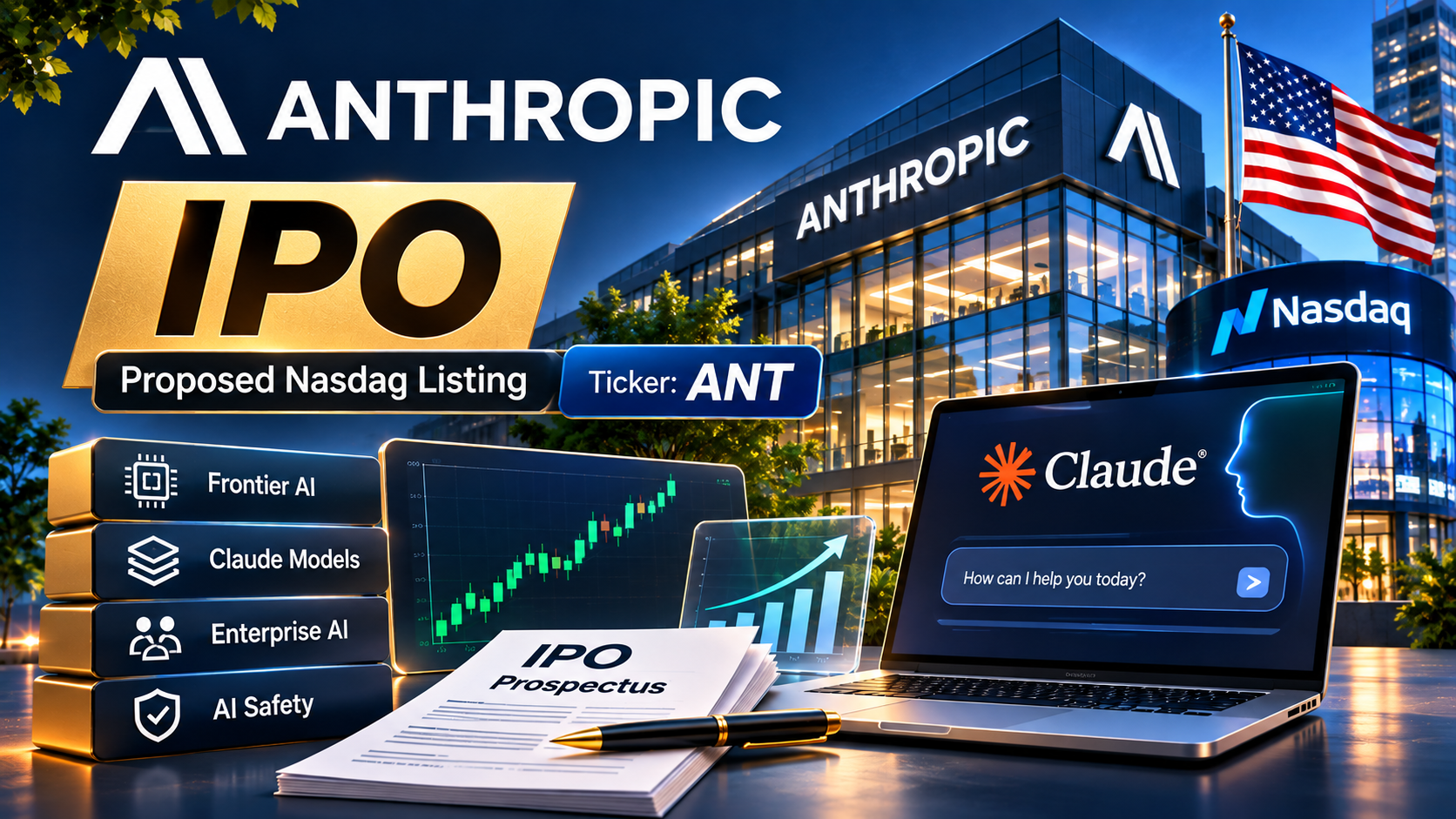
Anthropic, the artificial intelligence company behind Claude, is preparing for one of the biggest technology IPOs in history. The company has filed its registration statement with the US Securities and Exchange Commission (SEC) and is planning to list its shares on the Nasdaq Global Select Market under the ticker symbol ANT.
The proposed IPO has attracted enormous attention because Anthropic is not just another technology startup. It is one of the leading developers of advanced artificial intelligence models, competing directly with OpenAI, Google and other major technology companies.
The preliminary prospectus dated November 10, 2026, indicates an expected IPO price range of $70 to $78 per share. Anthropic plans to offer 825 million shares, potentially raising approximately $64.4 billion at the upper end of the price range. In addition, the company has arranged a separate $26 billion private placement with major technology companies and strategic investors.
But the size of the offering is only one part of the story.
Anthropic has reported extraordinary revenue growth, expanding enterprise adoption and a rapidly growing customer base. At the same time, it has disclosed substantial losses, enormous infrastructure commitments and a governance structure that gives founders and an independent trust significant influence over the company.
In this article, we examine the Anthropic IPO in detail, including its business model, financial performance, proposed valuation, major investors, risks and what investors in India should understand before considering exposure to the company.
Important: This article is based on Anthropic’s preliminary prospectus dated November 10, 2026, its November 2026 IPO fact sheet and publicly reported IPO developments available as of November 13, 2026. The IPO price and other offering terms remain subject to change.
1. Anthropic IPO 2026: Key Details
Here are the important details of the proposed Anthropic IPO based on its preliminary prospectus.
| IPO detail | Information |
|---|---|
| Company | Anthropic, PBC |
| Business | Artificial intelligence and enterprise AI |
| Main product | Claude |
| Proposed exchange | Nasdaq Global Select Market |
| Proposed ticker | ANT |
| IPO price range | $70–$78 per share |
| Total shares offered | 825 million |
| Shares offered by Anthropic | 801.35 million |
| Shares offered by existing shareholders | 23.65 million |
| Potential gross IPO proceeds | Up to approximately $64.4 billion |
| Concurrent private placement | $26 billion |
| Lead underwriters | Goldman Sachs and Morgan Stanley |
| Other underwriters | J.P. Morgan, Citigroup, Barclays and others |
| Expected trading date | November 19, 2026, subject to the offering process |
The proposed offering includes both newly issued shares and shares being sold by existing shareholders.
Anthropic itself plans to sell approximately 801.35 million Class A shares. Existing shareholders will sell approximately 23.65 million shares. The company will not receive proceeds from the secondary shares sold by those existing shareholders.
There is also an option for underwriters to purchase up to an additional 123.75 million shares from Anthropic.
The proposed ticker symbol is ANT, which investors should watch for on Nasdaq once the listing becomes effective.
Source: Anthropic preliminary IPO prospectus.
2. What Is Anthropic and What Does the Company Do?
Anthropic is an artificial intelligence research and development company founded in 2021 by Dario Amodei, Daniela Amodei and a group of former AI researchers.
The company focuses on developing advanced AI systems with an emphasis on safety, reliability and responsible deployment.
Its best-known product is Claude, a family of AI models designed to assist individuals, developers and businesses with tasks such as:
- Writing, research and analysis.
- Software development and coding.
- Business process automation.
- Data analysis and document processing.
- Customer support and enterprise workflows.
- Complex reasoning and multi-step tasks.
Anthropic’s business is increasingly focused on enterprise customers rather than relying exclusively on individual subscriptions.
Its products are available through direct subscriptions, enterprise agreements and its developer platform, where businesses can integrate Claude into their own applications.
The company also distributes its products through cloud marketplaces, including those operated by Amazon Web Services and Google Cloud.
Who are Anthropic’s competitors?
Anthropic operates in a highly competitive market.
Its major competitors include:
- OpenAI: Developer of ChatGPT and other advanced AI models.
- Google: Offers Gemini and its broader AI infrastructure.
- Microsoft: Develops AI products and distributes AI services through its cloud and software ecosystem.
- Meta: Develops Llama and other AI technologies.
- Other AI companies: Including emerging model developers and specialised enterprise AI providers.
Anthropic’s ability to maintain its position in this market will depend on model performance, pricing, enterprise adoption, computing capacity and its ability to continue developing competitive AI products.
3. How Does Anthropic Make Money?
Anthropic primarily generates revenue through a consumption-based model that it describes as pay-for-intelligence.
Customers pay according to their usage of Claude models, with pricing linked to the model selected and the number of tokens processed.
For example, a business integrating Claude into its customer-support platform may pay according to how much its customers use the AI service.
The more applications and workflows a customer runs through Claude, the greater the potential revenue for Anthropic.
The company also earns subscription revenue from individual and enterprise customers.
Anthropic’s revenue sources
| Revenue source | How it works |
|---|---|
| Consumption-based revenue | Customers pay according to their usage of Claude models |
| Subscriptions | Customers pay recurring fees for specified access and usage |
| Enterprise agreements | Businesses purchase Claude for internal workflows and applications |
| Developer platform | Companies integrate Claude into their own software and applications |
| Cloud marketplaces | Customers access Claude through cloud service providers |
Consumption-based revenue is the company’s largest revenue stream.
According to its prospectus, consumption-based revenue accounted for approximately 79% of total revenue during the first nine months of 2026. Subscription revenue contributed approximately 21%.
This model offers significant growth potential because customers can increase their usage as they integrate AI into more business processes.
However, it also creates uncertainty. A substantial portion of revenue depends on customer usage rather than long-term fixed subscriptions.
4. Anthropic Financial Performance: Revenue Growth and Losses
This is arguably the most important section for investors.
Anthropic’s revenue growth has been extraordinary. Its business has expanded rapidly as enterprises and developers increasingly adopt Claude.
However, the company is still dealing with substantial infrastructure and operating costs.
Anthropic’s revenue growth
The company’s reported revenue has increased sharply over the past few years.
| Financial period | Revenue |
|---|---|
| FY 2023 | $41 million |
| FY 2024 | $386 million |
| FY 2025 | $4.6 billion |
| First nine months of 2025 | $2.5 billion |
| First nine months of 2026 | $33.2 billion |
| Q3 2026 alone | $17.0 billion |
Revenue for the first nine months of 2026 increased approximately 1,206% compared with the corresponding period in 2025.
The company also reported a revenue run rate of approximately $81 billion as of October 2026.
A revenue run rate is an annualised estimate based on a recent period’s revenue or business activity. It should not be confused with actual full-year revenue or a guaranteed future result.
<caption>Source: Anthropic’s November 2026 IPO fact sheet and preliminary prospectus.</caption>
Is Anthropic profitable?
Not yet on a consistent GAAP basis.
For the first nine months of 2026, Anthropic reported:
| Financial metric | First nine months of 2026 |
|---|---|
| Revenue | $33.2 billion |
| Operating loss | $1.3 billion |
| Net loss | $104.0 billion |
| Adjusted operating income | $4.1 billion |
At first glance, the $104 billion net loss looks alarming. However, it needs to be understood in the context of the company’s accounting.
Approximately $94.3 billion of the net loss came from changes in the fair value of convertible notes, derivative liabilities and related financing instruments.
These are largely valuation-related accounting expenses rather than equivalent cash operating expenses.
That does not mean the company’s losses can simply be ignored. Investors should distinguish between GAAP net income, operating performance, cash flow and management’s adjusted financial measures.
The operating loss of $1.3 billion is a more direct indication of the company’s operating performance during the period, although cash flow and capital expenditure requirements also matter.
A positive sign: Improving adjusted operating performance
Anthropic reported adjusted operating income of $4.1 billion for the first nine months of 2026, compared with an adjusted operating loss of $3.1 billion in the corresponding period of 2025.
For Q3 2026, adjusted operating income was $2.5 billion, with an adjusted operating margin of 15%.
However, its GAAP operating result moved from operating income of $974 million in Q2 2026 to an operating loss of $567 million in Q3 2026.
The company attributed much of this change to additional short-term computing costs and non-cash charges related to its donation-matching programme.
The takeaway is that Anthropic is showing signs of improving operating efficiency, but sustainable profitability remains an important question.
5. Anthropic’s Biggest Challenge: Computing and Infrastructure Costs
Artificial intelligence is an extremely capital-intensive industry.
Developing advanced AI models requires enormous computing power, specialised chips, data centres, electricity and engineering resources.
Anthropic needs these resources not only to train new models but also to operate Claude for millions of users and enterprise customers.
The company’s prospectus discloses approximately $900.9 billion in aggregate committed spending under purchase commitments and lease agreements, substantially all related to computing and infrastructure.
Of this amount:
- Approximately $451.6 billion is expected to be incurred before the end of 2030.
- Approximately $70.7 billion is due in the 12 months following September 30, 2026.
- Most of the remaining commitments are expected between 2031 and 2045.
These are long-term commitments, not an immediate cash payment of $900 billion.
Nevertheless, they represent substantial future financial obligations.
Why does this matter?
Anthropic’s revenue is largely based on customer usage, and much of that revenue is not guaranteed under long-term contracts.
Its infrastructure commitments, on the other hand, can require payments over several years.
This creates a potential mismatch: the company must secure computing capacity in advance, even though future customer demand and revenue may not develop exactly as expected.
If customer adoption continues growing rapidly, these investments could support substantial future revenue.
But if demand slows, technology changes or infrastructure becomes underutilised, the commitments could put pressure on cash flow and profitability.
Anthropic reported $146.6 billion in liquidity as of September 30, 2026, before accounting for the proposed IPO and concurrent private placement. This included cash, short-term investments and available credit.
That provides a significant financial buffer, but the scale of its future commitments makes capital management a key issue for investors.
6. Who Is Investing $26 Billion in Anthropic Alongside the IPO?
One of the most interesting aspects of the Anthropic IPO is the separate $26 billion private placement involving major technology companies.
According to the preliminary prospectus, the following companies have agreed to purchase Class N shares, subject to the offering and other conditions.
| Strategic investor | Proposed investment |
|---|---|
| $10 billion | |
| NVIDIA | $10 billion |
| AMD | $2.5 billion |
| Broadcom | $1 billion |
| Micron | $1 billion |
| Microsoft | $1 billion |
| TSMC | $500 million |
| Total | $26 billion |
These investments are separate from the public IPO.
The shares issued through the private placement will be Class N shares, which generally do not carry voting rights while held in that class.
Why are these investments important?
These companies are not simply financial investors. They are also important participants in the AI infrastructure ecosystem.
- Google provides cloud infrastructure and AI computing resources.
- NVIDIA supplies GPUs used for AI training and inference.
- AMD develops competing AI accelerators.
- Broadcom participates in semiconductor and networking infrastructure.
- Micron supplies memory technology.
- Microsoft provides cloud and technology infrastructure.
- TSMC manufactures advanced semiconductors.
The investments demonstrate the strategic importance of Anthropic within the broader AI industry.
However, investors should also recognise the interconnected nature of these relationships. Some of these companies are suppliers, commercial partners, investors or competitors in different parts of the AI value chain.
7. Anthropic IPO Valuation: Is It Worth $1 Trillion or More?
Valuation is where the Anthropic IPO becomes particularly interesting.
Reuters has reported that the proposed IPO could value Anthropic at up to approximately $1.4 trillion on a fully diluted basis, while the valuation excluding certain options and restricted stock is around $1 trillion.
These figures depend on the share-count methodology used. Investors should not confuse the fully diluted valuation with a simple calculation using only the shares being offered to the public.
At the midpoint of the proposed IPO price range, $74 per share, the prospectus estimates approximately $84.6 billion in net proceeds for Anthropic from the public offering and concurrent private placement, before considering the underwriters’ additional-share option.
The valuation reflects expectations of enormous future growth in AI adoption, enterprise spending and demand for computing services.
What does the valuation mean for investors?
A company valued at around $1 trillion is already being priced as one of the world’s largest technology businesses.
Investors are not simply paying for Anthropic’s current revenue. They are also paying for the possibility that Claude becomes a major platform for enterprise software, automation, coding and other knowledge-based work.
The important question is whether Anthropic can convert its rapid revenue growth into sustainable profits and cash flow.
If it succeeds, the valuation could eventually be supported by a much larger business.
If growth slows, margins disappoint or competition intensifies, the market could reassess the premium valuation.
Why traditional valuation methods may be difficult
Anthropic is not yet a mature, consistently profitable company.
Traditional price-to-earnings valuation is therefore not particularly useful at this stage.
Investors may instead examine:
- Price-to-sales ratio.
- Enterprise value-to-revenue.
- Revenue growth.
- Adjusted operating margins.
- Cash flow and infrastructure spending.
- Customer retention and enterprise adoption.
- Long-term capital requirements.
Even these metrics need careful interpretation because AI companies have unusual infrastructure and financing requirements.
A high revenue growth rate alone does not establish that an IPO is attractively priced.
8. Anthropic’s Unique Governance Structure: Who Will Control the Company?
Anthropic is incorporated as a Public Benefit Corporation (PBC) under Delaware law.
This structure requires the company to balance shareholder interests with its stated public benefit purpose.
Anthropic’s stated purpose is the responsible development and maintenance of advanced AI for the long-term benefit of humanity.
It has also established a Long-Term Benefit Trust (LTBT), which is designed to help oversee the company’s commitment to responsible AI development.
The governance structure includes different classes of shares.
| Share class | Main characteristics |
|---|---|
| Class A | Publicly offered shares, generally carrying one vote per share |
| Class N | Primarily held by strategic partners; generally non-voting |
| Class T | Gives the Long-Term Benefit Trust authority over the election of a majority of the board |
| Class F | Held by the founders’ entity and carries 50.1% of total voting power on specified general shareholder matters |
| Class E | Designed for employees and has voting rights on limited matters |
This is an unusual arrangement for a publicly listed company.
It means that investors purchasing Class A shares will have an economic interest in Anthropic but will not necessarily have voting influence proportional to their investment.
The Long-Term Benefit Trust has an important role in board composition, while the founders retain significant voting influence through Class F shares.
This structure is intended to protect Anthropic’s long-term mission and AI safety priorities.
However, investors should understand that they will not have the same level of influence over corporate decisions as shareholders in a conventional one-share-one-vote company.
9. Major Risks of Investing in the Anthropic IPO
Anthropic operates in a market with enormous growth potential, but there are several risks investors should examine before considering the IPO.
1. Extremely high valuation
A valuation approaching $1 trillion or more leaves little room for disappointment.
If Anthropic fails to meet the growth expectations built into its IPO valuation, its share price could face significant pressure.
2. Intense competition
Anthropic competes with some of the world’s largest technology companies, including OpenAI, Google, Microsoft and Meta.
AI models are evolving rapidly. A competitor developing a more capable or cheaper model could affect Anthropic’s customer growth and pricing power.
3. Massive infrastructure commitments
The approximately $900.9 billion in disclosed compute and infrastructure commitments represent a substantial long-term obligation.
If customer demand does not grow sufficiently, these commitments could put pressure on cash flow.
4. Continued losses and uncertain profitability
Despite rapid revenue growth, Anthropic has reported substantial GAAP losses.
The company must demonstrate that it can translate revenue growth and improved efficiency into sustainable profitability.
5. Customer and distribution concentration
Anthropic reported that its top five customers represented approximately 25% of revenue during the first nine months of 2026.
In addition, sales through cloud service provider marketplaces represented approximately 44% of revenue during that period.
This creates dependence on a limited number of customers and distribution channels.
6. Dependence on strategic partners
Amazon and Google are important investors, infrastructure providers and commercial partners.
These relationships provide access to computing capacity and distribution, but they also create potential conflicts of interest because these companies participate in the wider AI market.
7. Regulatory and AI safety risks
Governments around the world are developing rules for AI systems.
Changes in regulation, restrictions on AI applications, security incidents, intellectual property disputes or safety-related issues could affect Anthropic’s operations and growth.
8. Share dilution and governance limitations
The prospectus describes multiple share classes, future equity incentive plans and the possibility of additional share issuances.
These could dilute public shareholders’ economic interests. The special voting arrangements also limit the influence of ordinary Class A shareholders.
9. IPO volatility
Large, highly anticipated IPOs can experience substantial price movements after listing.
Strong initial demand does not guarantee that the stock will remain above its IPO price.
Investors should also examine lock-up expiry dates and the possibility of additional shares entering the market.
10. Is Anthropic IPO Open for Retail Investors?
The proposed offering is a US IPO, not an Indian IPO.
Anthropic has applied to list on the Nasdaq Global Select Market under the ticker ANT.
The preliminary prospectus describes an offering of Class A shares. Whether individual retail investors can receive an allocation will depend on the final distribution arrangements, participating brokers and applicable eligibility requirements.
The offering should not be confused with a public issue available through India’s NSE or BSE IPO application process.
Investors in India who want exposure to US-listed companies generally need an eligible international investing platform or broker that supports US equities.
Before investing, they should check:
- Whether the broker supports participation in US IPOs or only post-listing trading.
- Account-opening and KYC requirements.
- Currency conversion and remittance costs.
- Applicable RBI Liberalised Remittance Scheme (LRS) requirements.
- US and Indian tax implications.
- Brokerage, custody and other transaction charges.
Buying a stock after it begins trading on Nasdaq is different from receiving an allocation in the IPO.
Indian investors should also understand that the stock will be traded in US dollars and will carry currency risk in addition to the company’s business and share-price risks.
11. Should You Invest in Anthropic IPO?
Anthropic is one of the most important companies in the global AI industry, and its IPO could become a landmark event for technology markets.
There are several reasons investors may find the company attractive:
- Rapid revenue growth.
- Increasing enterprise adoption.
- Strong demand for Claude and AI-powered applications.
- Strategic relationships with major technology companies.
- A growing role in software development and business automation.
- Potential long-term growth as AI becomes integrated into more industries.
However, there are equally important reasons to remain cautious.
The proposed valuation is enormous, the company has reported substantial GAAP losses, and its infrastructure commitments are exceptionally large.
The central investment question is not whether AI will become an important technology. It is whether Anthropic can generate enough durable revenue and cash flow to justify the valuation investors are being asked to pay.
For investors, it may be more sensible to evaluate the final IPO price, fully diluted valuation, share structure and post-listing performance rather than making an investment decision based only on the excitement surrounding AI.
Our view: Anthropic is an important company to watch, but a strong business does not automatically mean its IPO is attractively priced. Investors should separate the long-term opportunity in AI from the price they are paying for the stock.
12. Frequently Asked Questions About Anthropic IPO
1. What is the Anthropic IPO ticker symbol?
Anthropic has applied to list its Class A common stock on the Nasdaq Global Select Market under the ticker symbol ANT.
2. What is the expected Anthropic IPO price?
The preliminary prospectus dated November 10, 2026, indicates an expected price range of $70 to $78 per share. The final IPO price may differ.
3. When will Anthropic shares start trading?
Trading is currently expected to begin on November 19, 2026, subject to completion of the IPO process and the effectiveness of the registration statement.
4. How much money is Anthropic planning to raise?
The proposed public offering comprises 825 million shares. At the upper end of the $70–$78 price range, the gross offering value could reach approximately $64.4 billion.
Anthropic has also arranged a separate $26 billion private placement with strategic investors.
5. Who owns Anthropic?
Anthropic was founded in 2021 by Dario Amodei, Daniela Amodei and other AI researchers. It has received investments from major technology companies and institutional investors, including Amazon and Google.
Its ownership structure includes multiple share classes and strategic investors.
6. Is Anthropic profitable?
Anthropic reported an operating loss of $1.3 billion and a GAAP net loss of approximately $104 billion for the first nine months of 2026.
However, $94.3 billion of the net loss was associated with changes in the fair value of convertible notes, derivative liabilities and related instruments. The company also reported positive adjusted operating income, which is a non-GAAP measure.
7. What is Anthropic’s revenue in 2026?
Anthropic reported revenue of $33.2 billion for the first nine months of 2026, compared with $2.5 billion during the same period in 2025. Its revenue run rate was approximately $81 billion as of October 2026.
8. What is Anthropic’s estimated valuation?
Reuters has reported a potential valuation of up to approximately $1.4 trillion on a fully diluted basis. The valuation excluding certain options and restricted stock has been reported at around $1 trillion. The precise valuation depends on the final IPO price and share-count methodology.
9. Can Indian investors apply for the Anthropic IPO?
Anthropic is planning a US listing on Nasdaq, not an Indian public issue on NSE or BSE. Indian investors would need an eligible international brokerage or investing platform that supports the relevant US securities and IPO participation, subject to applicable rules and broker availability.
10. Is Anthropic the same company as OpenAI?
No. Anthropic and OpenAI are separate AI companies. Both develop advanced AI models and compete in areas such as enterprise AI, coding, research and AI-powered applications.
11. Does Anthropic pay dividends?
Anthropic has stated in its preliminary prospectus that it has never paid cash dividends and does not expect to pay dividends in the foreseeable future. It intends to retain available funds to finance its operations and expansion.
Conclusion
The Anthropic IPO represents a major milestone for the artificial intelligence industry.
The company has demonstrated exceptional revenue growth, strong enterprise adoption and the ability to attract substantial investment from some of the world’s largest technology companies.
At the same time, its financial statements reveal the challenges of building frontier AI systems. Massive computing requirements, long-term infrastructure commitments, competitive pressure and the path towards sustainable profitability will remain important factors.
The proposed IPO valuation also means investors will need to assess the company’s future potential carefully.
For the broader market, Anthropic’s listing could become an important test of investor appetite for large AI companies and the financial sustainability of the AI infrastructure boom.
For individual investors, the key is to look beyond the excitement surrounding the IPO and understand the business, financials, valuation and risks before making an investment decision.
Sources and References
- Anthropic – Preliminary IPO Prospectus, November 10, 2026
- Anthropic – IPO Fact Sheet, November 2026
- Anthropic – Confidential Draft S-1 Announcement
- Reuters – Anthropic IPO and proposed valuation
- Reuters – Anthropic IPO demand and oversubscription report
Disclaimer: This article is for educational and informational purposes only and does not constitute investment advice or a recommendation to buy or sell any security. IPO terms, pricing and listing dates can change. Investors should read the final prospectus and assess their financial circumstances, risk tolerance and applicable regulatory and tax requirements before investing.
Why Did the Magnificent 7 Stocks Dominate Wall Street? Read More