
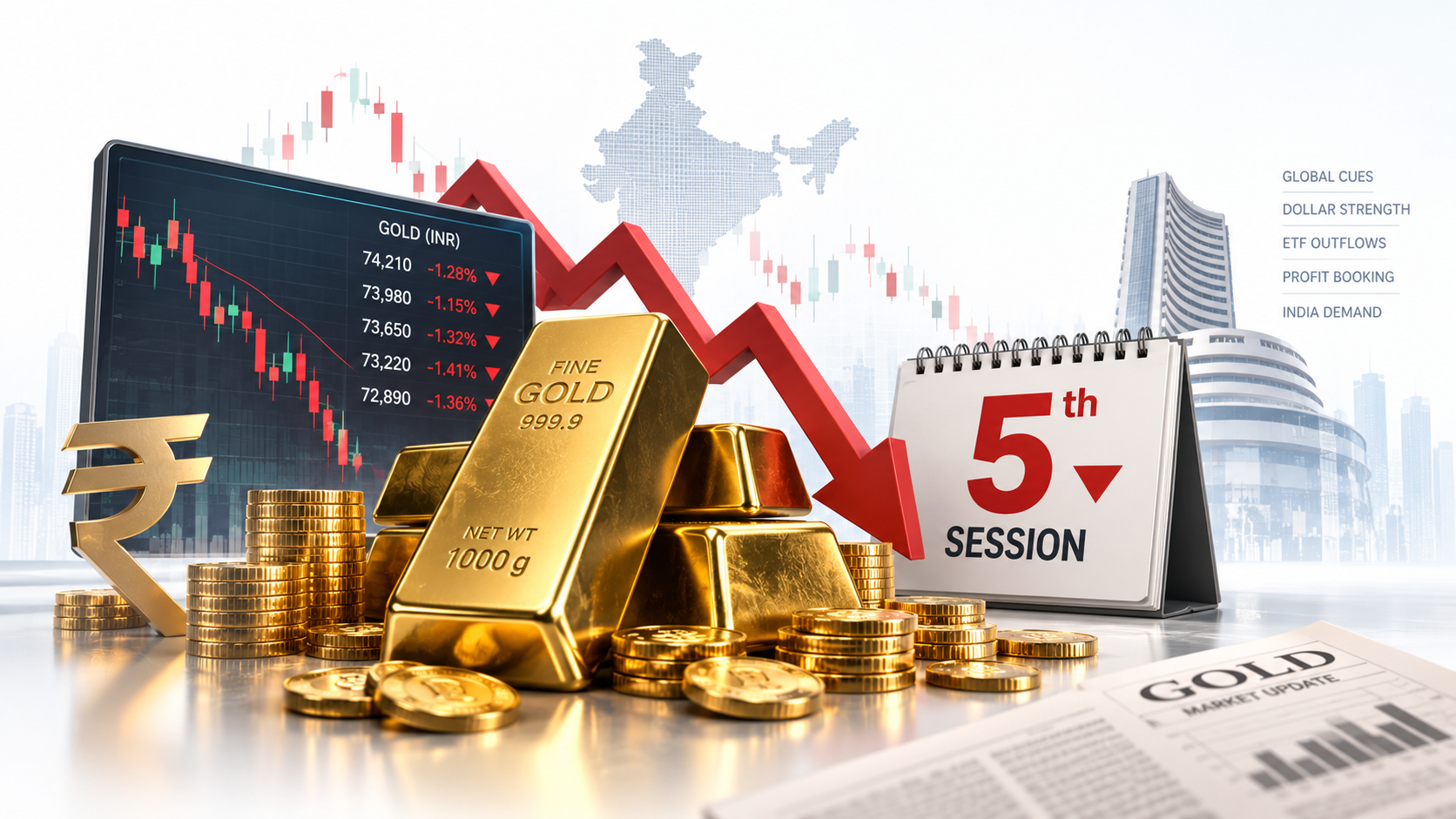
Gold Price in India Falls for a Fifth Straight Session: Here’s What’s Actually Going On
Gold price today in India has extended its slide for a fifth consecutive session, and if you’ve checked the rate on your jeweller’s WhatsApp status this week and flinched, you’re not imagining things. Gold price today stands at around ₹15,409 per gram for 24-karat gold (₹1,54,090 for 10 grams) as of September 2, 2026, down from a record high just last week. On the MCX, gold futures fell as much as 1.4% in a single session, and the pullback over the past week has stretched past 6.5% — one of the sharpest weekly corrections gold has seen all year.
For a metal that Indian households treat as a birthday-gift default and a wedding-season non-negotiable, a five-day losing streak is the kind of thing that gets forwarded in family WhatsApp groups within minutes. So let’s break down what’s actually happening, why it’s happening, and more usefully what it means for you, whether you’re buying a gold coin for Diwali or sitting in a locker.
What Happened: The Numbers So Far
Here’s how gold price today compares with the trend over the past few sessions, based on domestic bullion market data:
- August 31: 24K gold at ₹1,55,430 per 10 grams
- September 1: 24K gold at approximately ₹1,52,790–1,54,090 per 10 grams (city-wise variation), MCX gold down 1.38% intraday
- September 2: 24K gold at ₹15,409 per gram nationally (₹1,54,090/10g); Mumbai rates near ₹15,202/gram, Delhi near ₹15,423/gram
Silver has followed a similar script, trading around ₹2,45,000–2,50,000 per kg, down from August’s highs near ₹2,60,000. Internationally, spot gold slipped toward a nearly four-week low, with Comex gold hovering around $4,400–4,437 an ounce and under pressure to test levels below $4,300. Domestic futures prices can be tracked live on the Multi Commodity Exchange of India (MCX), while daily reference rates for bullion are published by the India Bullion and Jewellers Association (IBJA).
Here’s the context that matters, though: even after this pullback, gold is still sitting on gains of more than 6.5% for the month and over 45% for the year. Think of it like a cricket team that’s lost the last two overs of a T20 innings after batting brilliantly for 18 — the scoreboard still looks healthy, it’s just that the momentum has cooled off, sharply.
Why Gold Is Falling: The Real Drivers
1. A Stronger US Dollar Is Squeezing Gold
Gold is priced in dollars globally, and when the dollar strengthens, gold gets more expensive for buyers holding other currencies — which dampens demand and pulls prices down. It’s a bit like your favourite imported chocolate brand suddenly costing more in rupees purely because the exchange rate moved, even though nothing changed about the chocolate itself. Right now, the dollar has been putting in a strong performance, and that alone is doing a lot of the heavy lifting in gold’s decline.
2. Inflation Concerns and Rate-Hike Bets
Elevated crude oil prices — partly linked to an escalating Middle East conflict pushing crude to fresh multi-month highs — are stoking inflation worries. That, in turn, is reviving bets that the US Federal Reserve may need to keep interest rates higher for longer. Higher rates make interest-bearing assets like bonds more attractive relative to gold, which pays no interest at all. It’s the financial equivalent of choosing a fixed deposit over keeping cash in a locker: if the FD suddenly starts paying more, the locker looks a lot less appealing.
3. Profit-Booking After a Blistering Rally
Gold had rallied hard through the year, touching record highs just days before this correction began. After a run like that, some amount of profit-booking is almost inevitable — big institutional investors and traders locking in gains after a stretch of outsized returns. Picture someone who bought a flat two years ago in an area that’s since seen prices shoot up 45%; at some point, a chunk of owners will sell to lock in that profit, and that selling itself puts pressure on prices. Gold is going through a version of that right now.
4. Global Cues Feeding Into Domestic Prices
It’s worth remembering that gold prices in India aren’t set by local jewellers or wedding demand — they’re a function of international bullion prices adjusted for the rupee-dollar exchange rate, import duties, and local taxes. So when Comex gold in New York dips, your neighbourhood jeweller’s rate card updates within hours, not days.
What This Means for You
If You’re Buying Gold for a Wedding or Festival
Checking gold price today before you step into a jewellery store is worth the two minutes it takes.
A falling market is, in the plainest terms, a better entry point than buying at last week’s record high. If you have a purchase planned for the coming weeks — Diwali, a wedding, an anniversary gift — this dip works in your favour. That said, nobody can predict exactly when the correction bottoms out, so if the amount is large, consider staggering your purchase across two or three instalments rather than putting everything into one day’s rate. It’s the same logic as SIPs in mutual funds: you’re not trying to time the market perfectly, you’re trying to average out the risk.
If You Already Own Gold (Jewellery, Coins, or Digital Gold)
Don’t panic-sell. A five-session dip, even a sharp one, sits inside a year where gold is still up more than 45%. If your gold is a long-term holding — inherited jewellery, wedding gold, or gold bought as a hedge — short-term volatility like this is largely noise. Selling into a dip to “cut losses” on an asset that’s still deeply in the green for the year rarely makes sense unless you have an immediate cash need.
If You Hold Gold ETFs or Sovereign Gold Bonds
You’ll see this reflected directly in your portfolio value over the next few sessions. It’s a reminder that gold, despite its “safe haven” reputation, is not immune to sharp corrections — it’s a liquid, globally-traded asset that reacts to dollar strength, rate expectations, and profit-booking just like any other asset class. If gold is part of a diversified portfolio at a sensible allocation (many advisors suggest 5–15%), a correction like this is exactly the kind of short-term swing that allocation is designed to absorb.
Bull Case vs Bear Case
The bull case: Gold remains a long-term inflation hedge and currency-debasement hedge. If global rate-cut expectations return, if the dollar weakens again, or if geopolitical risk escalates further, gold could resume its climb quickly — it has a history of sharp V-shaped recoveries after corrections.
The bear case: If the US dollar continues to strengthen and the Fed signals a prolonged higher-rate stance, gold could see further downside before stabilising. A crowded trade that rallied over 45% in a year is also naturally vulnerable to deeper corrections as leveraged positions get unwound.
The honest answer: Nobody — no analyst, no brokerage, no newsroom — can tell you with certainty where gold goes from here in the next week. What the data does show is a market repricing after an exceptional run, driven by identifiable macro factors rather than panic.
Investor Takeaway: What to Watch Next
- US Federal Reserve commentary on interest rates — any dovish shift could support gold; a hawkish tone could extend the fall.
- Crude oil prices and the Middle East situation — continued escalation keeps inflation fears alive, which cuts both ways for gold.
- Dollar index (DXY) movement — a weaker dollar is typically gold-positive, and vice versa.
- Domestic demand cues — Indian festive and wedding-season buying (October–December) has historically provided a floor under prices.
- Your own time horizon — short-term traders may want to wait for stabilisation; long-term buyers can treat this as a staggered buying opportunity rather than a reason to sit out entirely.
- Rate check before buying — since gold price today can shift more than once during trading hours, confirm the live rate at the point of purchase rather than relying on yesterday’s number.
Conclusion
Gold price today reflects a real, data-backed correction — a five-session slide — not noise, and not (yet) a trend reversal. It’s being driven by a stronger dollar, inflation-linked rate-hike expectations, and natural profit-booking after one of gold’s strongest years in recent memory. For everyday buyers, that translates into a more reasonable entry point than last week’s record highs; for existing holders, it’s a moment to check your allocation rather than your nerves. As always with a fast-moving commodity like gold, verify the day’s rate before you buy, factor in GST and making charges on jewellery, and avoid making large one-shot decisions based on a single day’s headline.
FAQs
Q1. Why is gold price today falling for 5 days in a row in India?
A combination of a stronger US dollar, rising crude oil prices stoking inflation fears, expectations of prolonged high US interest rates, and profit-booking after gold’s sharp rally earlier this year.
Q2. Is this a good time to buy gold in India?
It’s a better entry point than last week’s record highs, though nobody can predict exactly when the correction ends. Many analysts suggest staggering large purchases across a few sessions rather than buying all at once.
Q3. Will gold prices recover soon?
That depends largely on US Federal Reserve rate decisions, the dollar’s trajectory, and global geopolitical developments. Gold has historically recovered sharply after corrections, but timing is never guaranteed.
Q4. Why do gold rates differ between Indian cities?
While the base price follows international bullion trends, local taxes, transportation costs, and dealer margins cause small city-to-city variations in the final quoted rate.
Q5. Should I sell my gold jewellery now?
Not typically, if it’s a long-term holding. Gold is still up significantly for the year despite this correction, so short-term dips usually aren’t a strong reason to sell inherited or long-held gold.
Click Here to learn about this week’s Nifty 50 analysis
Disclaimer
This article is for informational purposes only and does not constitute investment advice. Gold and silver rates mentioned are indicative, sourced from domestic bullion market and MCX data as of September 2, 2026, and can vary by city, jeweller, and time of day. Prices exclude GST, making charges, and other applicable costs. Readers are advised to verify current rates and consult a registered financial advisor before making investment or purchase decisions. Past performance is not indicative of future returns.